
Understanding salary benchmarks in Pakistan can make or break critical career decisions in 2026. Whether evaluating a job offer, planning a career switch, or researching the Pakistani labor market for hiring purposes, accurate compensation data shapes everything from negotiation strategies to relocation choices. The challenge? Salary information across Pakistan varies widely by sector, location, experience level, and gender. This includes a documented gender pay gap for similar work that significantly impacts market realities, labor law compliance, and career paths.
This complete guide breaks down the average salary in Pakistan across multiple areas. Inside, discover:
- How compensation compares across major industries and key sectors.
- What professionals earn in different regions and locations.
- How experience levels impact earning potential throughout career growth.
What is Average Salary in Pakistan?
Average salary in Pakistan refers to the standard earnings of the working population within a set period. It is determined by combining the total pay of all employees, covering basic wages and cash allowances, and dividing this figure across the total number of workers. Unlike the minimum wage, which acts as a legal baseline, this figure reveals the true earning potential for skilled roles.
Employers rely on this data to build competitive offers that secure talent, while job seekers use it to check their market worth and negotiate pay that matches their experience. This average typically reflects the gross salary (total package) rather than just the basic wage. It shows the total monthly value of a job offer before tax is removed, rather than just the cash received in hand.
Average Salary Overview in Pakistan (2026)
Average salaries in Pakistan vary significantly across professions, industries, and experience levels. Understanding these key salary metrics helps job seekers evaluate offers accurately and allows employers to benchmark compensation effectively against the 2026 market.
The Calculated Average
The mathematical average salary in Pakistan is PKR 82,100 per month (approximately USD 292–296), calculated by dividing total national earnings by the workforce size. However, this figure is heavily influenced by high earners in the corporate sector and does not always reflect the ground reality. The median salary of PKR 70,700 serves as a more reliable baseline for typical professional earnings.
Key Salary Figures
Minimum Wage:
- PKR 40,000 per month is the statutory minimum wage across major provinces including Punjab, Sindh, and Balochistan.
- Translates to approximately PKR 1,423 per day for daily wage earners.
- Annual minimum wage: PKR 444,000,
Median Salary:
- PKR 70,700 per month represents the median income threshold.
- This means 50% of the workforce earns more than this amount, while the other half earns less.
- Provides a more realistic picture of typical earnings than mathematical averages.
Salary Range:
- Lower end: PKR 20,700 per month (Typical for entry-level, internships, and unskilled positions).
- Upper end: PKR 365,000+ per month (Common for senior management, C-level executives, and specialized roles).
- Sector Impact: High-demand industries like Healthcare and IT often exceed these upper ranges significantly due to talent shortages.
Annual and Hourly Breakdown:
- Average annual earnings: PKR 985,200 (USD ~3,524).
- Average hourly wage: PKR 470 (USD ~1.68).
- Freelance Insight: This hourly metric is particularly useful for remote workers and freelancers calculating their base rates for international clients.
Salary by Industries Types in Pakistan
Salary benchmarks in Pakistan vary across the market, with specialized sectors offering significantly higher compensation than standard roles. Understanding these industry-specific pay scales helps job seekers target high-growth areas and employers benchmark competitive salaries effectively.
Highest-Paying Industries
Information Technology (IT): This sector leads national salary benchmarks for 2026, driven by rapid growth in export-focused software development. Professionals here earn competitive monthly wages, though specialized roles like IT Heads and System Designers secure higer compensation. Remote work opportunities with international firms often push these earnings far above local averages due to dollar-based income.
Key positions:
- Software Engineer: PKR 50,000-250,000 monthly
- IT Director: PKR 180,000-224,000 monthly
- IT Architect: PKR 180,000-214,000 monthly
- Cybersecurity Manager: PKR 50,000-150,000 monthly
Healthcare and Medical: This sector remains one of the most stable and financially rewarding in the country. Physicians and surgeons see a significant difference in earnings based on private practice success and specialization level, with experienced consultants sitting at the top of this bracket. Allied roles, including dentists, also secure strong market rates.
Typical salary ranges:
- Physicians and Surgeons: PKR 61,000-462,000 monthly
- Dentists: PKR 87,000-250,000 monthly
- Healthcare Data Analyst: PKR 70,000-90,000 monthly
- Medical Specialists: PKR 150,000-300,000 monthly
Finance and Banking: Professionals in this domain, especially credentialed CA professionals, secure some of the highest executive packages available. Earnings depend heavily on seniority and firm size. Corporate banking roles offer solid baselines, with branch management and risk assessment positions occupying the higher end of the scale.
Key roles:
- Chartered Accountant: PKR 100,000-1,000,000 monthly
- Finance Manager: PKR 150,000-200,000 monthly
- Bank Manager: PKR 103,000-296,000 monthly
- Finance Officer: PKR 40,000-60,000 monthly
Engineering: Traditional engineering disciplines offer varied compensation heavily influenced by project type and specialization. Petroleum engineers lead the sector, while electrical professionals also maintain strong earning potential, particularly with opportunities in large-scale infrastructure projects domestically and in the Middle East.
Industry breakdown:
- Petroleum Engineer: PKR 120,000-180,000 monthly
- Electrical Engineer: PKR 80,000-150,000 monthly
- Mechanical Engineer: PKR 75,000-140,000 monthly
- Civil Engineer: PKR 70,000-130,000 monthly
Mid-Range Industries
- Telecommunications: Professionals earn competitive salaries averaging PKR 60,000-100,000 monthly, driven by Pakistan’s expanding mobile and internet infrastructure. Network engineers and telecommunications specialists benefit from steady demand as connectivity continues growing nationwide.
- Digital Marketing: Digital marketing has emerged as a high-growth field with salaries ranging from PKR 50,000 to PKR 150,000 depending on experience. SEO specialists, social media managers, and content creators enjoy flexibility and strong earning potential, particularly when working with international clients.
- Construction and Manufacturing: Construction workers earn PKR 50,000-90,000 monthly on average, while manufacturing sector salaries range from PKR 50,000 to PKR 80,000 depending on role and industry subsector. Senior positions in construction management and manufacturing operations command higher compensation.
Lower-Paying Industries
- Agriculture and Food Industry: General workers here typically see modest earnings of PKR 35,000 to PKR 75,000. While specialized agricultural engineers secure better rates, this sector generally offers lower financial ceilings compared to the technology and corporate worlds.
- Retail and Services: Entry-level positions usually align with minimum wage standards, ranging from PKR 37,000 to PKR 55,000. However, consistent career progression into store management can eventually raise these earnings into the PKR 80,000 to PKR 120,000 bracket.
Average Salaries by Professions in Pakistan
Professional roles in Pakistan secure distinct pay scales driven by academic qualifications, specialized skills, and market experience. These compensation levels vary across the sector, reflecting the specific technical demands and seniority required for each position.
| Professions | Average Monthly Salary | Salary Range |
| Chief Executive Officer | PKR 267,410 | PKR 200,000-400,000+ |
| Surgeon/Medical Specialist | PKR 250,000 | PKR 150,000-1,200,000 |
| IT Director | PKR 220,000 | PKR 180,000-300,000 |
| Chartered Accountant | PKR 200,000 | PKR 100,000-1,000,000 |
| IT Architect | PKR 190,000 | PKR 180,000-280,000 |
| Software Engineer | PKR 100,000 | PKR 50,000-250,000 |
| Finance Manager | PKR 150,000 | PKR 120,000-220,000 |
| Sales Director | PKR 170,000 | PKR 130,000-250,000 |
| Petroleum Engineer | PKR 110,000 | PKR 100,000-220,000 |
| Dentist | PKR 120,000 | PKR 87,000-250,000 |
| Bank Manager | PKR 150,000 | PKR 103,000-296,000 |
| Marketing Manager | PKR 110,000 | PKR 80,000-180,000 |
| Civil Engineer | PKR 100,000 | PKR 70,000-150,000 |
| Electrical Engineer | PKR 115,000 | PKR 80,000-160,000 |
| Graphics Designer | PKR 50,700 | PKR 35,000-90,000 |
| Healthcare Data Analyst | PKR 70,000 | PKR 60,000-110,000 |
| Administrative Assistant | PKR 40,000 | PKR 30,000-50,000 |
| Data Entry Operator | PKR 45,000 | PKR 30,000-60,000 |
| General Laborer | PKR 35,000 | PKR 35,000-55,000 |
| Agricultural Worker | PKR 37,000 | PKR 35,000-65,000 |
Average Monthly Salaries by Cities/Regions
Location is a primary factor determining pay scales in Pakistan. Major economic centres provide higher compensation to balance the cost of living and retain skilled professionals. Urban hubs like Karachi and Lahore consistently pay more than smaller regions due to the density of multinational firms and heavy industrial activity.
| City | Average Monthly Salary | Key Industries | Cost of Living Status |
| Karachi | PKR 80,000 | Finance, Port, Corporate | Medium (High Utilities) |
| Islamabad | PKR 76,700 | Tech, Gov, NGOs | High (Expensive Rent) |
| Lahore | PKR 75,000 | Tech, Media, Education | Medium |
| Faisalabad | PKR 65,000 | Textiles, Industry | Low |
| Peshawar | PKR 60,000 | Trade, Services | Low |
- Islamabad: Offers high salaries, but high rents (often 30–40% of income) can eat up your raise.
- Karachi & Lahore: Offer the best balance, salaries are high, but housing options are more varied, allowing for better potential savings.
- The Remote Work Equalizer: Tech professionals working remotely for international firms earn the same (often in USD) regardless of location. Living in a lower-cost city like Multan or Faisalabad while earning a global salary is currently the smartest financial move in Pakistan.
How Experience Affects Salary Growth?
Your experience level is a main factor in how much your salary grows in Pakistan. As you move forward in your career, your pay increases, but the speed of that growth changes over time. The biggest jumps usually happen in the first 10 years, after which the yearly increases tend to slow down.
| Experience Level | Salary Increase vs Previous Level | Cumulative Increase vs Entry-Level |
| Entry-Level (0-2 years) | Baseline | 0% |
| Junior (2-5 years) | +32% | +32% |
| Mid-Level (5-10 years) | +21% | +60% |
| Senior (10-15 years) | +14% | +82% |
| Expert (15-20 years) | +9% | +98% |
| Executive (20+ years) | +9% | +116% |
Average Salary in Pakistan By Education Level
Your academic qualification sets the foundation for your earning capacity in Pakistan, but practical skills are what influence actual income growth. With each step up in education, salary brackets shift upward, showing that formal education delivers consistent long-term returns when combined with the right expertise.
| Education Level | Average Increase Over Baseline | Typical Monthly Salary Range |
| Primary School | +27% | PKR 35,000-45,000 |
| Middle School | +40% | PKR 37,000-45,000 |
| High School/Matric | +50% | PKR 45,000-50,000 |
| Intermediate/College | +57% | PKR 55,000-60,000 |
| Bachelor’s Degree | +71% | PKR 65,000-110,000 |
| Master’s/Tertiary Education | +82% | PKR 80,000-150,000+ |
A Bachelor’s degree holder earns approximately 71% more than a worker with only primary education. However, it is important to note that the upper end of these salary ranges (e.g., PKR 110,000+) is usually reserved for candidates who combine their degree with high-demand market skills.
Public vs Private Sector Salary Comparison
The decision between government and private employment in Pakistan goes beyond just the monthly paycheck. While the public sector often offers higher starting wages and allowances for entry-level roles, the private sector typically provides faster financial growth and greater earning potential for top management.
| Category | Public Sector (Govt) | Private Sector |
| Overall Average | +12% Higher | Baseline |
| Clerical Staff | +34% Higher | -34% Lower |
| Skilled Workers | +25% – 30% Higher | -25% – 30% Lower |
| Mid-Management | +10% – 15% Higher | -10% – 15% Lower |
| Senior Executives | -10% – 20% Lower | +10% – 20% Higher |
| Female Workers | +28% – 76% Higher | Baseline |
Government jobs provide significant financial stability and higher earnings for support staff, skilled workers, and women. However, as professionals reach senior executive levels, the private sector overtakes the public sector, offering significantly higher compensation packages to reward top leadership.
How Industry Growth Rates Affect Salaries?
The expansion rate of an industry directly shapes the yearly raises its employees receive. Sectors expanding rapidly due to global needs or technology shifts typically offer higher annual increases to keep their workforce.
| Industry | Annual Average Increase | Growth Trend |
| Information Technology | 6% – 13% | High Demand |
| Healthcare | 8% – 12% | Stable Growth |
| Banking & Finance | 5% – 8% | Moderate |
| Manufacturing | 4% – 6% | Consistent |
| Education | 3% – 5% | Slow |
- Top Performers: IT and Healthcare professionals consistently secure the highest salary increases. This is the result of a shortage of skilled talent and strong export needs in the tech space.
- Stable Sectors: Banking growth has stabilized compared to previous years, offering predictable but moderate raises.
- Slower Growth: Education remains among the sectors with lower financial growth, often lagging behind the national inflation rate.
Experience-Based Increment Patterns
Your career stage plays a major role in determining your yearly raise. As professionals move from entry-level roles to leadership positions, their bargaining power improves, leading to higher percentage hikes.
| Career Stage | Experience Level | Annual Increment Range |
| Junior Professionals | 0–5 Years | 3% – 5% |
| Mid-Level Pros | 5–10 Years | 6% – 9% |
| Senior Experts | 10–15 Years | 10% – 15% |
| Top Management | 15+ Years | 15% – 20% |
It is important to note that these figures apply strictly to internal annual reviews. Professionals who switch employers often bypass these limits, securing significantly higher jumps (typically 20–30%) compared to staying with the same organization.
Gender Pay Gap Analysis in Pakistan
The workforce in Pakistan faces a distinct wage gap based on gender, where female employees earn considerably less than their male counterparts despite often holding equal or higher degrees. The ILO Gender Pay Gap Report shows that this inequality continues across all sectors, representing one of the highest gaps among lower-middle-income countries.
| Category | Pay Gap Percentage | Context |
| Hourly Wages (Overall) | 25% less | Female staff earn 25% less per hour than males. |
| Monthly Wages (Overall) | 30% less | The gap widens due to fewer paid hours worked. |
| Informal Sector | 40%+ less | Highest disparity due to lack of oversight |
| Low Education Level | 40%+ less | Largest gap among workers with minimal education |
| High Education Level | 15-20% less | Education partially mitigates but doesn’t eliminate gap |
| Public Sector | 5-10% less | Smallest gap due to standardized pay scales |
| Private Sector (Formal) | 25-30% less | Moderate gap with some regulation |
| Agriculture & Manufacturing | 35%+ less | Higher than service sector disparities. |
Beyond wage differences, severe challenges exist regarding employment entry. The female employment rate stands at just 23% compared to 79% for men, creating a 56 percentage point employment gap, the largest in South Asia. Currently, female professionals represent only 13.5% of total wage employees, despite making up nearly half of Pakistan’s working-age population.
Minimum Wage vs Living Wage Gap in Pakistan
The gap between the minimum wage and the living wage in Pakistan highlights a significant difference in worker compensation. While the government sets the legal baseline employers must pay, the living wage represents what workers actually need to afford basic necessities for themselves and their families.
Current Minimum Wage (The Legal Baseline)
As of 2026, Pakistan’s statutory minimum wage is PKR 40,000 per month across major provinces. This standard applies to unskilled workers in sectors like manufacturing, construction, and agriculture.
The minimum wage translates to:
- Daily Rate: PKR 1,423
- Annual Income: PKR 444,000 – 480,000
- Hourly Rate: Approximately PKR 178 (based on an 8-hour workday)
The Wage Gap Reality
Recent analysis by the Centre for Labour Research shows that even with the revised minimum wage of PKR 40,000, there remains a financial gap of PKR 11,706. This translates to a 29% shortfall between what workers legally earn and what they actually need to live.
| Metric | Minimum Wage (Legal) | Living Wage (Required) | Gap / Shortfall |
| Monthly Pay | 40,000 | 51,706 | – 11,706 |
| Annual Pay | 480,000 | 620,472 | – 140,472 |
| Coverage | Individual Worker | Family of Three | Basic Needs |
Benefits & Compensation Packages in Pakistan
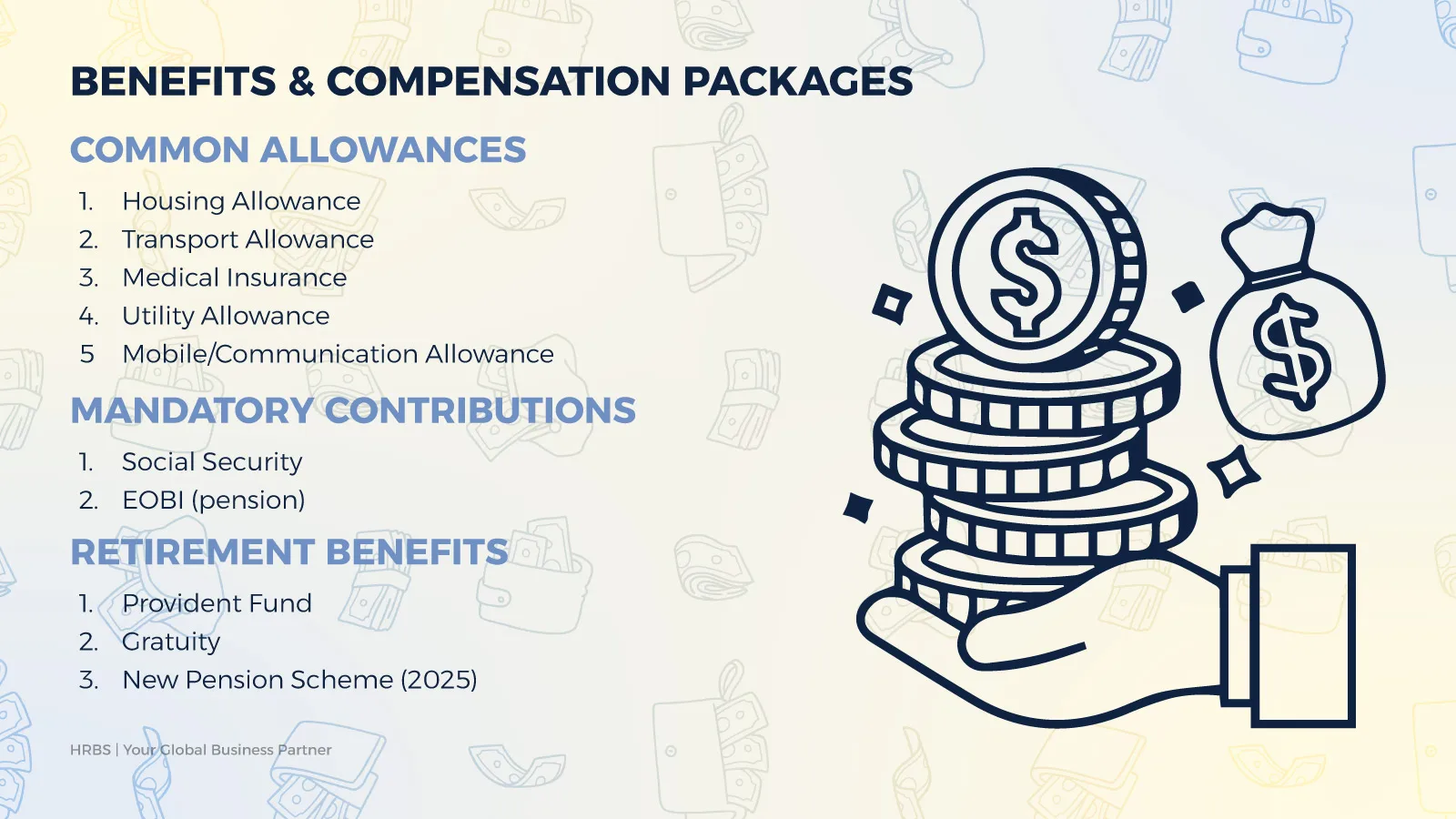
Salary packages extend far beyond simple base pay, often including allowances and mandatory benefits that can increase total compensation by 30–50%. Understanding these specific components helps candidates compare job offers and evaluate their true earning potential.
Common Salary Allowances
- Housing Allowance: This is typically the largest component after base pay, generally calculated as 45–50% of the basic salary, and is often tax-exempt up to certain legal limits.
- Transport Allowance: Companies usually offer between PKR 5,000 and PKR 20,000 monthly depending on the position level, covering commuting costs or providing company-maintained vehicles for senior roles.
- Medical Insurance: Most employers provide health coverage for employees and their immediate family members, featuring cashless hospitalization at network hospitals.
- Utility Allowance: This payment covers electricity, gas, and internet expenses, a benefit particularly common for senior positions or remote work arrangements.
- Mobile/Communication Allowance: Roles requiring regular business contact often include PKR 2,000–10,000 monthly to cover mobile and data usage.
Mandatory Contributions
Employers are legally required to contribute to social security programs, ensuring a safety net for the workforce:
- Social Security: Employers contribute 5–6% of the employee’s salary.
- EOBI (pension): Employers contribute 5% of the minimum wage, while employees contribute 1% to both schemes.
Retirement Benefits
- Provident Fund(PF): A popular savings scheme where both employer and employee contribute 8–10% of the basic salary monthly to an interest-bearing account, fully accessible upon retirement.
- Gratuity: A lump sum paid upon resignation or retirement, typically calculated as (Last year’s salary ÷ 26) × 30 × years of service.
- Pension Scheme (Government): Public sector employees hired after July 2024 contribute 10% of their salary, matched by a 12% employer contribution, which is managed by professional pension fund managers.
What Total Compensation Looks Like?
A position offering a PKR 80,000 base salary typically delivers a much higher total value when all benefits are factored in.
| Component | Estimated Value (PKR) |
| Base Salary | 80,000 |
| Housing Allowance (45%) | 36,000 |
| Transport Allowance | 10,000 |
| Medical Insurance Value | 5,000 – 8,000 |
| Total Monthly Package | 131,000 – 134,000 |
When evaluating job offers, calculate total compensation by adding base salary plus all allowances and employer contributions. A lower base salary with comprehensive benefits often provides greater value than a higher base salary with minimal perks.
How to Negotiate Salary Packages in Pakistan?
Successful salary negotiation in Pakistan starts with thorough market research and knowing the current industry standards. Job seekers should enter the discussion with clear data on typical pay for the position, considering their skills, experience, and city.
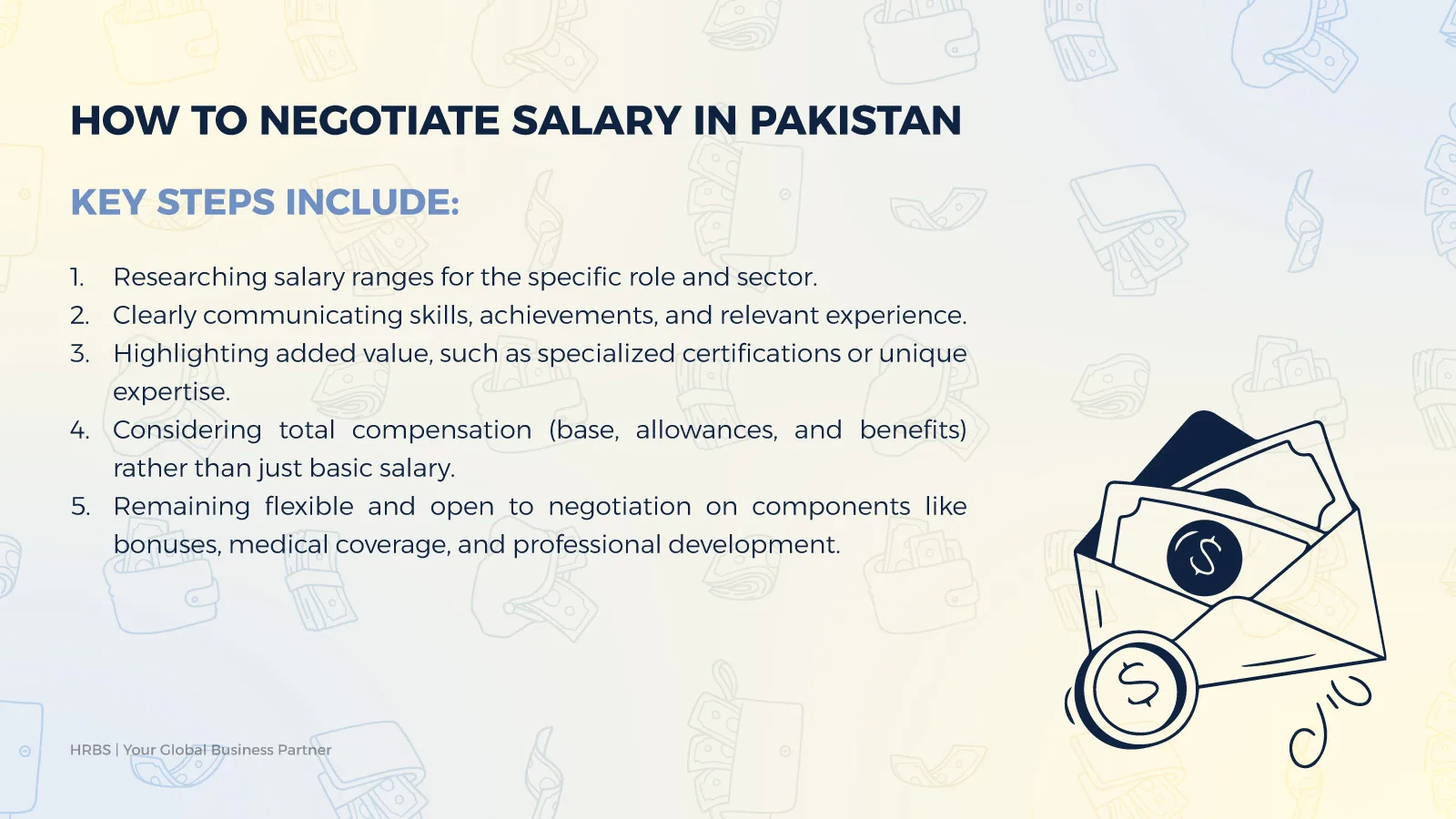
Key steps include:
- Check the Numbers: Research specific salary ranges for the role and sector to set a realistic target.
- Show Your Value: Clearly state your skills, past wins, and relevant work history to support your request.
- Focus on Total Pay: Look at the gross salary (base pay plus allowances) rather than just the basic wage, ensuring the offer covers fuel, medical, and utility benefits.
- Highlight Expertise: Point out extra value, such as specialized certifications or unique technical knowledge that sets you apart.
- Stay Flexible: Be open to discussing non-cash items like performance bonuses, health insurance limits, and paid training if the monthly cash offer is fixed.
Maintaining polite but confident communication, backed by real market data and personal success, significantly improves the chance of a positive outcome in Pakistani salary discussions.
Conclusion
Navigating salary benchmarks in Pakistan goes beyond simple averages. To understand the true earning potential within the national labor market, one must consider critical variables including industry demand, geographic location, and specialized skills. While educational qualifications establish a baseline, years of practical experience and existing gender pay gaps continue to heavily influence final compensation packages.
For the Pakistani workforce, the expanding economy offers significant potential. Organizations that leverage these market-competitive insights can successfully secure top talent, while professionals who base their negotiations on accurate data can align their career choices with their financial goals. Ultimately, in a market guided by gross salary structures, knowing the numbers is the first step toward securing the right offer.
FAQs
What is a good salary in Pakistan?
A good salary in Pakistan depends on location, lifestyle, and family size. In major cities, PKR 100,000-150,000 monthly allows comfortable living with savings potential for a family of four. Single professionals can live comfortably on PKR 60,000-80,000 in urban areas, while PKR 200,000+ enables upper-middle-class lifestyle with private education and home ownership potential.
How much do fresh graduates earn in Pakistan?
Fresh graduates typically earn PKR 30,000-60,000 monthly depending on field and employer. Engineering graduates start at PKR 40,000-70,000, business graduates at PKR 35,000-55,000, and IT graduates at PKR 45,000-80,000. Multinational companies and tech startups offer higher starting salaries (PKR 60,000-100,000) compared to local SMEs.
How much income tax will be deducted from my salary?
For the 2025-2026 fiscal year, no tax is deducted if your annual income is below PKR 600,000 (PKR 50,000/month). For income between PKR 600,001 and PKR 1.2 million, the tax is 5% of the amount exceeding 600k. As your salary rises, the tax rate increases progressively; for example, earning PKR 200,000 monthly (2.4M annual) results in a tax liability of roughly PKR 162,000 per year, or PKR 13,500 monthly.
Which city pays the highest salary in Pakistan?
Karachi offers the highest average salaries at PKR 88,700 monthly, followed closely by Lahore (PKR 87,200) and Faisalabad (PKR 85,700). Islamabad ranks fourth at PKR 76,700 despite being the capital, though it offers better quality of life and lower living costs than Karachi.
What is the highest paying job in Pakistan?
Chief Executive Officers earn the highest salaries, averaging PKR 267,410 monthly with top earners exceeding PKR 400,000. Medical specialists and surgeons earn PKR 150,000-1,200,000 monthly depending on specialization. Chartered Accountants can earn PKR 100,000-1,000,000 monthly based on experience and firm size.
Is overtime pay mandatory in Pakistan?
Yes, under Pakistani labor law (Factories Act 1934), if you work beyond 9 hours a day or 48 hours a week, you are legally entitled to overtime pay. The standard rate for overtime is double (2x) your ordinary hourly wage. However, this rule is strictly enforced mostly in the industrial and manufacturing sectors, while corporate or “white-collar” roles often treat extra hours as unpaid expectations or compensate via annual performance bonuses instead.
How can I increase my salary in Pakistan?
The fastest way to increase your salary is by combining specialized certifications in high-demand fields like IT or data analysis with strategic job switching. While internal promotions typically offer small raises, changing employers every 3 to 4 years can result in increases of 20–30%. Furthermore, moving into management roles or completing a Master’s degree can permanently raise your earning baseline by over 80% compared to staying in a basic role.
What is upper-middle-class salary in Pakistan?
Upper-middle-class households in Pakistan typically earn PKR 200,000-400,000 monthly. This income level enables homeownership, private school education for children, car ownership, international travel, comprehensive healthcare, and significant savings. It represents the top 10-15% of wage earners in the country.
Do men and women earn equal salaries in Pakistan?
No, women in Pakistan earn 25-30% less than men for comparable work. The gender pay gap is largest in informal sectors (40%+) and smallest in public sector (5-10%). Women with higher education still face 15-20% wage disadvantages, while those with low education experience 40%+ gaps.
What benefits should I expect in a Pakistan salary package?
Standard benefits include housing allowance (45-50% of basic salary), transport allowance (PKR 5,000-20,000), medical insurance for family, provident fund contributions (8-10% employer match), gratuity upon retirement, and social security contributions. Total compensation packages typically add 30-50% to base salary through these benefits.
How often do salaries increase in Pakistan?
On average, employees in Pakistan receive salary revisions every 18 to 19 months, though this varies by sector. Private sector professionals typically see annual performance-based raises between 8% and 13%, while public sector staff receive standardized increments of roughly 7.5%. However, in high-growth industries like software development, annual adjustments often reach 15–20% to retain skilled talent.