
Managing global expansion often presents operational hurdles for businesses. Tracking evolving labor laws, tax codes, and regional employment standards can quickly become a complex task for growing teams.
Employer of Record (EOR) and Agent of Record (AOR) services offer a clear way to simplify operations and avoid common cross-border hiring gaps. The actual benefit comes from selecting a model that matches your risk management strategy rather than choosing based on short-term needs. While an EOR provides legal coverage against permanent establishment and tax liabilities for full-time staff, an AOR offers a dedicated setup for managing project-based contractors.
Connecting these models allows for a secure workforce, regardless of where your talent performs their duties. In this guide, we break down how to scale by matching your hiring requirements to the right solution.
Key Differences Between EOR and AOR
Choosing between an Employer of Record (EOR) and an Agent of Record (AOR) depends on the employment status of your global talent and your compliance requirements. This table outlines how these two models differ regarding legal liability, tax management, and worker classification.
| Feature | Employer of Record (EOR) | Agent of Record (AOR) |
| Worker Type | Full-time & Part-time Employees | Independent Contractors & Freelancers |
| Legal Employer | The EOR Provider | The Hiring Company (Client) |
| Compliance Focus | Labor law, payroll, & statutory benefits | Worker classification & documentation |
| Legal Relationship | Employment-based (Employment Contract) | Service-based (Service Agreement) |
| Payroll & Tax | EOR manages local payroll, tax & social contributions | Client pays via invoice; AOR facilitates |
| Risk Mitigation | Permanent Establishment (PE) & employment liability | Misclassification prevention |
| Operational Control | Client manages daily work & performance | Contractor maintains project autonomy |
| Best For | Long-term global team expansion | Short-term, project-based surges |
How an Employer of Record (EOR) Works?
An EOR functions as a bridge, allowing your company to hire talent in foreign countries without the need to incorporate a local legal entity. You maintain control over daily tasks and performance goals, while the EOR provides a specialized framework for legal employment.
Market Testing
Companies often wait to invest in a foreign entity because of the unclear long-term potential of a market. An EOR acts as a strategy for market entry. It allows you to hire a group to verify your product-market fit or service demand. If the market slows, you can end the operation without the high costs, tax filings, and legal complications involved in closing a company branch.
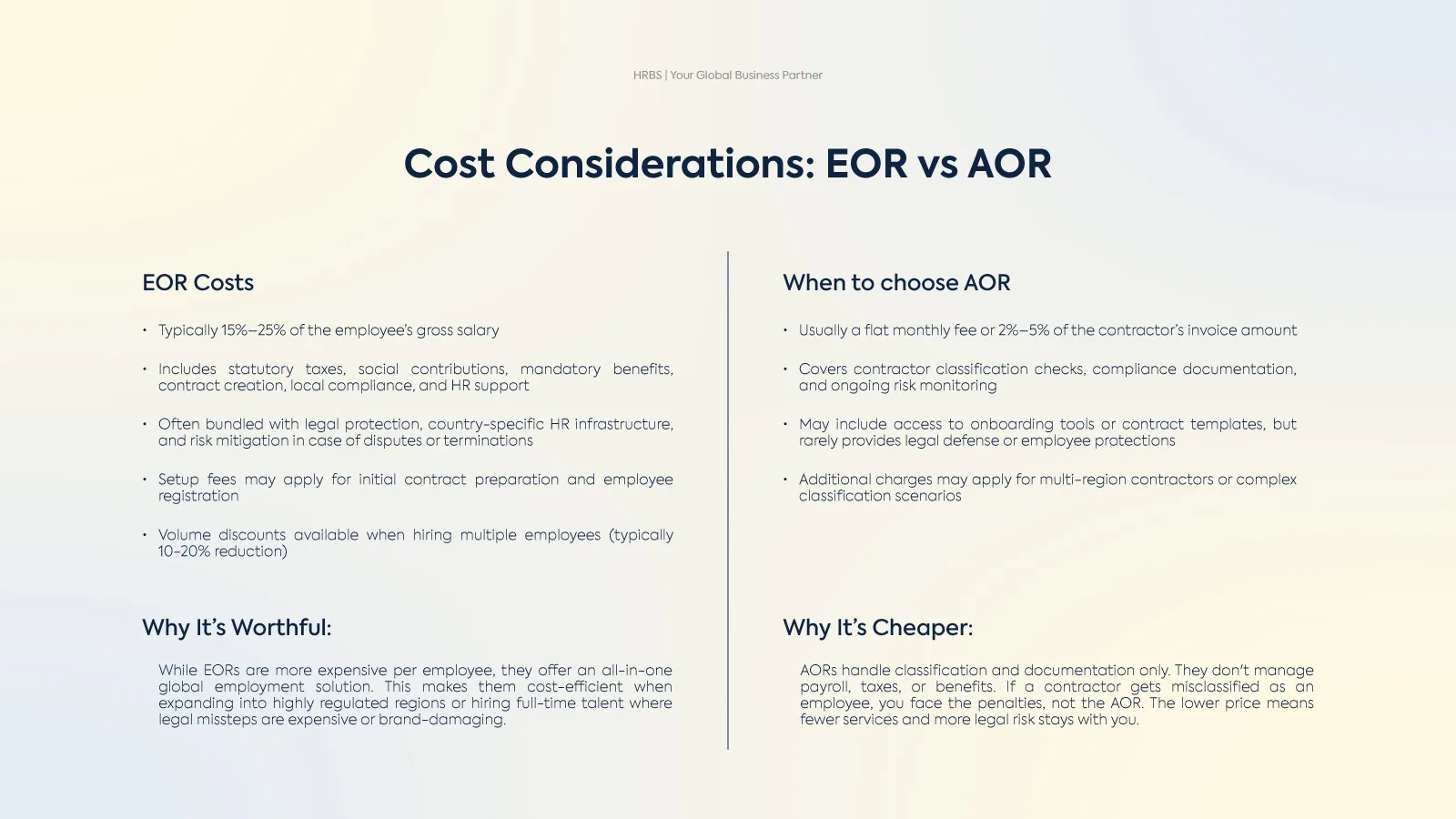
Cost Considerations: EOR vs AOR
Understanding cost differences between EOR and AOR models isn’t just about line items, it’s about what you’re actually getting (or risking) for that price.
EOR Costs
- Typically 15%–25% of the employee’s gross salary
- Includes statutory taxes, social contributions, mandatory benefits, contract creation, local compliance, and HR support
- Often bundled with legal protection, country-specific HR infrastructure, and risk mitigation in case of disputes or terminations
- Setup fees may apply for initial contract preparation and employee registration
- Volume discounts available when hiring multiple employees (typically 10-20% reduction)
Why It’s Worthful: While EORs are more expensive per employee, they offer an all-in-one global employment solution. This makes them cost-efficient when expanding into highly regulated regions or hiring full-time talent where legal missteps are expensive or brand-damaging.
AOR Costs
- Usually a flat monthly fee or 2%–5% of the contractor’s invoice amount
- Covers contractor classification checks, compliance documentation, and ongoing risk monitoring
- May include access to onboarding tools or contract templates, but rarely provides legal defense or employee protections
- Additional charges may apply for multi-region contractors or complex classification scenarios
Why It’s Cheaper: AORs handle classification and documentation only. They don’t manage payroll, taxes, or benefits. If a contractor gets misclassified as an employee, you face the penalties, not the AOR. The lower price means fewer services and more legal risk stays with you.
Key Questions to Ask EOR and AOR Providers
Choosing the right provider requires evaluating operational reliability, legal protection, and global scalability. Use these questions to assess real capabilities beyond marketing claims.
Legal Protection & Employment Infrastructure
- How do you ensure adherence to local employment laws and tax regulations?
- Do you operate through owned entities or third-party partnerships in each location?
- What legal support do you provide during employment disputes or tax audits?
- How do you handle changes to labor regulations and tax codes?
Data Security & IP Protection
- What data protection protocols and certifications do you maintain (GDPR, ISO 27001)?
- Where is employee data stored, and who has access to it?
- How do you structure IP assignment clauses to ensure enforceability?
- What happens to sensitive data if the provider relationship ends?
Onboarding & Operational Speed
- What’s your typical timeline for employee onboarding in different regions?
- Can you provide references from clients who are hired in my target locations?
- What documentation do you need from us to start the onboarding process?
- How do you handle urgent hiring needs or expedited onboarding?
Pricing Transparency
- What’s included in your base pricing and what costs extra?
- Are there setup fees, offboarding charges, or early termination penalties?
- How do you handle currency conversion and international payment fees?
- What volume discounts are available as we scale?
Support Structure
- Do we get a dedicated account manager or shared support team?
- What are your support hours and response time commitments?
- How do you handle time zone differences for urgent issues?
- Can you provide local language support for employees?
Track Record & Stability
- How long have you operated in my priority locations?
- What’s your client retention rate and average partnership length?
- Can you share case studies of companies similar to ours?
- What’s your financial stability and backing?
Conclusion
The choice between EOR and AOR isn’t binary – it’s a strategic decision with long-term operational and legal consequences. An EOR gives you legal infrastructure to hire full-time employees without setting up an entity, but it also reshapes how you manage employment relationships across borders. It’s not just a payroll tool; it’s a liability shield, a compliance framework, and a speed-to-market enabler in countries with complex labor laws. An AOR, on the other hand, doesn’t just manage contractors – it defines your exposure. It’s lean, scalable, and cost-efficient, but the burden of misclassification risk remains largely on your shoulders.
Most companies underestimate this risk until it becomes a retroactive legal issue, one that could trigger fines, back pay, or forced employment recognition. There’s no one-size-fits-all solution. The real strategy is segmentation: use an EOR where legal protection and employment continuity matter, and deploy an AOR where speed, flexibility, and project-based work justify the risk. The companies that scale globally without regulatory damage are the ones that tailor their model to each use case, not the ones that pick the cheapest option upfront.
FAQ’s
What are the consequences of misclassifying a contractor under an AOR?
Misclassification can result in severe financial and legal penalties. Local authorities may reclassify a contractor as an employee, triggering retroactive tax obligations, unpaid benefits, severance liabilities, and statutory penalties. In some jurisdictions, it can escalate to labor court claims or trigger permanent establishment risk, which may subject the company to corporate taxation in that country.
Is AOR always more cost-effective than EOR?
Not necessarily. While AORs typically have lower upfront costs, they do not assume full compliance liability. This creates downstream risk exposure that, if triggered, can outweigh the initial savings. For companies hiring long-term, high-touch roles, the absence of benefits, legal protections, and employer control in an AOR setup can lead to turnover, disengagement, or forced reclassification, each carrying significant cost implications.
Can I switch from an EOR to my own legal entity later?
Yes. Many companies use EORs as a bridge solution while establishing their own legal entity. Once your entity is operational, you can transfer employees from the EOR to your direct employment. This requires proper transfer documentation to avoid employment gaps, benefit disruptions, or contractual issues. Some EORs offer transition support services to ensure smooth handoffs.
What happens to my employees if the EOR provider goes out of business?
This is a critical risk factor when selecting providers. If an EOR ceases operations, your employees’ legal employer disappears, creating potential employment gaps and unpaid obligations. Evaluate provider financial stability, ask about contingency plans, and review what happens to employee contracts if the provider exits.
Can I use different EOR providers in different locations?
Yes, though it adds administrative complexity. Some companies use specialized regional EORs with deep local expertise rather than one global provider. This works when you need a strong presence in specific locations or when a single provider lacks coverage. However, managing multiple EOR relationships means coordinating different contracts, platforms, billing cycles, and support teams.