The human resource outsourcing (HRO) market is rapidly expanding, valued at approximately USD 20 billion and expected to grow by 50% to reach USD 31 billion by 2030. Companies that outsource HR functions report up to 30% reductions in operating costs and significant improvements in efficiency and employee satisfaction.Many growing companies face rising HR demands that go beyond everyday tasks. Keeping up with changing employment laws, addressing employee concerns, and maintaining a positive work environment can overwhelm small HR teams. When HR responsibilities pile up, they slow down your focus on core business activities and impact employee satisfaction.
This often leads companies to consider whether expanding their internal HR team or outsourcing HR functions better suits their needs. The right choice depends on factors such as company size, specific HR needs, and long-term business goals. Understanding how each option affects your ability to manage recruitment challenges, stay compliant with employment regulations, and support employee engagement will help you make the best decision. This article explores the key differences between HR outsourcing and in-house HR, guiding you to find the best solution for your business needs and future success.
What is In-House HR?
In-house HR refers to having a dedicated human resources team or professional employed directly within your company to manage all workforce-related tasks. An internal HR team handles core functions such as talent acquisition, hiring, payroll processing, employee benefits administration, employee relations, and compliance with local labor laws.
Because they work closely with your organization every day, internal HR professionals maintain direct contact with both employees and leadership. This close connection helps build trust, maintain a strong company culture, and ensure that human resource policies align directly with business goals. Companies choose an in-house HR structure when they need immediate, face-to-face support, tight control over sensitive employee data, and a personalized approach to workforce management and retention.
When to Use In-House HR
Choosing an in-house human resources model makes strategic sense when your organization requires a dedicated internal presence to manage workforce dynamics. You should consider building or maintaining an internal HR team in the following situations:
- Building Company Culture: When fostering close, personal relationships with employees is essential to drive trust, engagement, and a positive workplace environment.
- Direct Management and Support: When your business requires immediate, day-to-day oversight of employee performance, training, and sensitive workplace relations with strict confidentiality.
- Matching Operational Goals: If your company size supports dedicated staff who ensure internal policies match your long-term business objectives and everyday workflows.
- Data Security and Strict Control: When protecting sensitive employee information and maintaining complete, in-house governance over HR data reduces internal risks related to data breaches.
- Fast, Localized Decision-Making: When you want consistent enforcement of company policies and rapid responses to internal employee matters to keep operations stable.
What is HR Outsourcing?
HR outsourcing involves partnering with an external company or third-party provider to handle some or all of your human resource functions. This model commonly includes tasks such as payroll processing, talent acquisition and recruitment, employee benefits administration, labor law compliance, and workforce training.
By utilizing outsourced HR services, businesses gain access to specialized industry expertise, advanced HR technology, and updated regulatory practices that internal teams may not have. This approach reduces the risk of costly compliance errors, lightens administrative workloads, and allows your business to scale HR operations efficiently while keeping the primary focus on core growth activities.
When to Use HR Outsourcing
Partnering with an external provider makes strategic sense when your business needs flexible support, specialized expertise, or relief from heavy administrative burdens. You should consider HR outsourcing in the following scenarios:
- RemovingAdministrative Overload: When your internal team spends too much time on routine tasks like payroll processing and benefits administration instead of focusing on core business goals.
- Managing Complex Compliance: When staying updated on changing employment laws, tax rules, and labor regulations becomes too challenging, helping to lower the risk of costly legal penalties.
- Scaling for Growth or Fluctuations: When your workforce size changes due to seasonal hiring, rapid expansion, or project-based demands that require flexible and scalable HR services.
- Improving Recruitment Capabilities: When your current hiring process lacks the speed, reach, or advanced tools needed to attract and secure top-tier candidates efficiently.
- Controlling Overhead Costs: When you want professional HR support and advanced technology without the high fixed expenses of hiring and maintaining a full internal department.
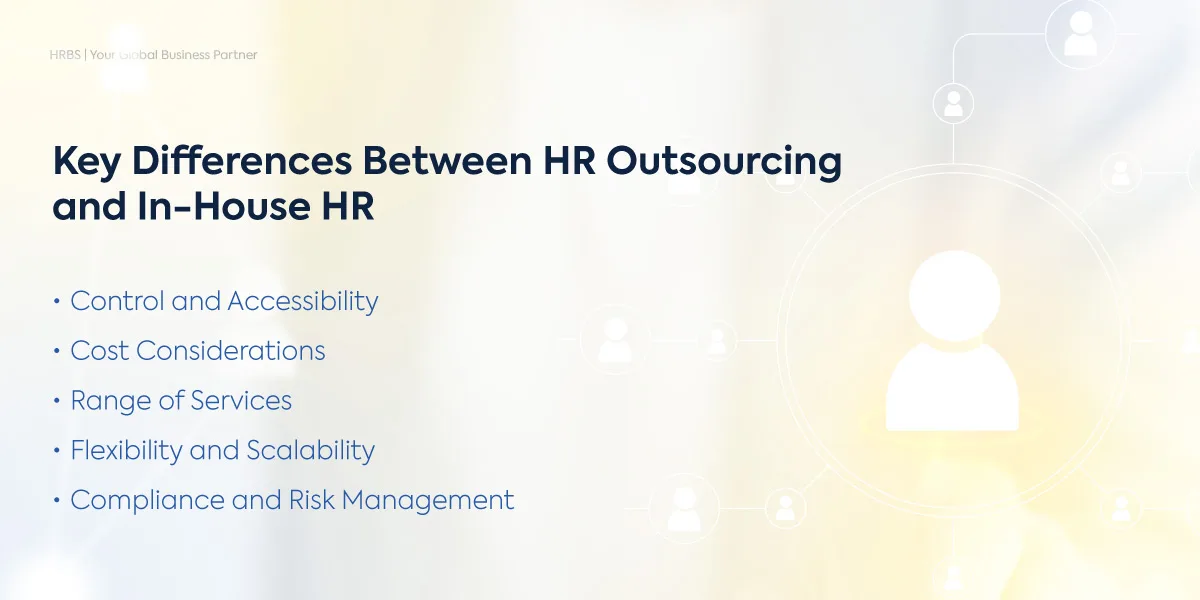
Key Differences Between HR Outsourcing and In-House HR
Choosing between an in-house human resources team and an outsourced model requires looking closely at how each approach impacts your daily operations, budget, and long-term growth. While both options cover essential workforce functions, they manage responsibilities, costs, and compliance in fundamentally different ways.
The core differences between HR outsourcing and in-house HR span several critical areas:
Control and Accessibility
- In-House HR: Provides immediate, face-to-face access to professionals who work inside your office, understand your daily environment, and can resolve employee concerns quickly. This direct contact helps build strong internal trust.
- HR Outsourcing: Involves working with external specialists who manage your HR functions remotely. While you do not have instant physical access, these providers bring broad, multi-industry experience and dedicated digital support desks.
Cost Structure and Overhead
- In-House HR: Involves fixed, ongoing expenses, including full-time salaries, employee benefits, continuous training, office space, and specialized software licenses. For smaller businesses, these costs add up quickly.
- HR Outsourcing: Typically operates on a scalable, pay-as-you-go or subscription model. You pay only for the specific services you use, which helps control expenses and lowers upfront capital requirements.
Range of Services and Expertise
- In-House HR: Handles a wide variety of tasks—from everyday onboarding and performance reviews to deep employee relations—applied through a personalized, company-specific lens.
- HR Outsourcing: Offers flexible, modular packages. You can choose to outsource specific functions like payroll processing and tax filing, or hand over complete human resource management to dedicated specialists.
Scalability and Workforce Flexibility
- In-House HR: Expanding or reducing an internal department takes time, recruitment effort, and restructuring costs, making it slower to adapt to sudden business shifts or seasonal market changes.
- HR Outsourcing: Offers high scalability. External providers can easily scale services up or down based on your current workforce size, making it ideal for seasonal businesses or rapid growth phases.
Compliance and Risk Management
- In-House HR: Internal teams must constantly monitor shifting federal, state, and local labor laws, which can increase the risk of costly mistakes if they lack specialized legal backgrounds.
- HR Outsourcing: Regulatory compliance is managed by dedicated legal and HR specialists who track law changes automatically, protecting your business from compliance errors and legal penalties.
Pros and Cons of HR Outsourcing vs. In-House HR
Here’s a simple table to help you quickly compare the advantages and disadvantages of HR outsourcing and in-house HR. This will help you decide which option fits your business needs better.
| Aspect | HR Outsourcing – Pros | HR Outsourcing – Cons | In-House HR – Pros | In-House HR – Cons |
| Cost | Lower variable pricing | Can grow costly over time | Fixed, predictable budget | High ongoing overhead |
| Expertise | Access to top specialists | Remote or distant staff | Deep company knowledge | Potential skill gaps |
| Flexibility | Easy to scale up or down | Harder to fit culture | Strong culture alignment | Slow to adjust size |
| Compliance | Automated legal tracking | Vendor reliability risk | Direct risk control | Prone to missing updates |
| Recruitment | Broad talent networks | Less hiring control | Personalized hiring touch | Limited local reach |
| Data Security | Secure enterprise cloud systems | Third-party data sharing risks | Complete internal data control | Vulnerable to internal security gaps |
| Employee Relations | Professional, objective handling | Less personal or empathetic touch | Builds strong personal trust | Prone to internal bias or favoritism |
| Technology | Instant access to advanced HR tech | Dependent on vendor software | Custom internal workflows | High software licensing costs |
| Admin Burden | Lifts heavy daily paperwork load | Requires internal point of contact | Dedicated hands-on management | Can get bogged down in routine tasks |
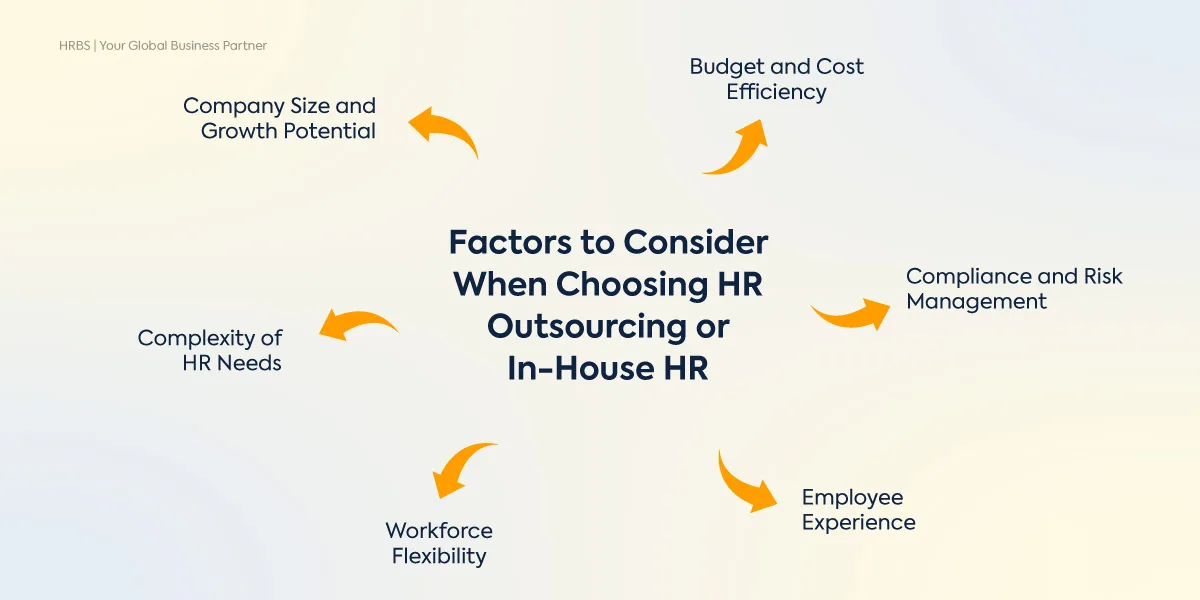
Factors to Consider When Choosing HR Outsourcing or In-House HR
Deciding between human resource outsourcing and building an internal team requires a careful evaluation of your company’s operational needs. To determine the right approach, assess the following critical factors:
- Company Size and Growth Rate: Smaller businesses and fast-growing startups typically benefit from HR outsourcing to gain professional capabilities without high overhead. Larger, established enterprises with stable headcount usually favor in-house teams to maintain direct supervision over internal workflows and culture.
- Budget and Cost Efficiency: In-house human resources involves fixed ongoing expenses, including salaries, benefits, office space, and software licenses. Outsourcing operates on a flexible, variable model where you pay only for utilized services, reducing upfront administrative costs.
- Compliance and Regulatory Complexity: If your business operates across multiple jurisdictions or faces complex labor laws, third-party experts reduce legal risks. Simpler organizational structures with predictable regulations can often be managed effectively by internal staff.
- Technology and Data Access: Modern human capital management (HCM) software and automated payroll tools are often instantly accessible through outsourcing partners, whereas building an internal tech stack requires significant capital investment.
- Culture and Daily Operations: When daily face-to-face employee trust, mentorship, and localized conflict resolution are core business drivers, an internal team is invaluable. When the priority is streamlining repetitive administrative workloads, outsourcing allows leadership to refocus on everyday business growth.
- Employee Experience: An in-house HR team can build stronger relationships with employees, offering immediate support and fostering a positive work environment. Outsourcing handles routine HR functions efficiently but may lack the personal touch that contributes to employee satisfaction and loyalty.
Conclusion
Choosing between HR outsourcing and building an in-house human resources team depends directly on your company size, budget, and specific operational requirements. Many growing businesses choose to outsource part or all of their HR functions to reduce fixed overhead expenses, streamline payroll and benefits administration, and minimize complex compliance risks.
At the same time, maintaining an internal HR team remains valuable for organizations that prioritize deep cultural alignment, direct employee trust, and hands-on, face-to-face workplace management. Carefully evaluating your current workforce demands, regulatory exposure, and growth trajectory will help you determine the best model for your business. Whether you choose external partnership or internal expansion, the right HR strategy will protect your organization, engage your employees, and support long-term success.
FAQ’s
What HR functions do companies commonly outsource?
Companies commonly outsource administrative, technical, and high-risk human resource tasks. The most frequently outsourced functions include payroll processing, tax filing, employee benefits administration, recruitment, labor law compliance management, and workforce training.
How does HR outsourcing improve employee satisfaction?
HR outsourcing improves employee satisfaction by providing access to advanced self-service employee portals, faster support resolution times, accurate and error-free payroll, and professionally managed benefits packages that enhance the overall employee experience.
Is HR outsourcing cost-effective for small businesses?
Yes, HR outsourcing is highly cost-effective for small businesses. It replaces high fixed overhead expenses—such as full-time salaries, continuous training, and expensive software licenses—with a flexible, predictable pay-as-you-go service model.
Can outsourcing HR help with compliance risks?
Yes, third-party HR providers employ regulatory and legal specialists who continuously track changing federal, state, and local employment laws. This expert oversight drastically minimizes your risk of expensive compliance errors and labor law penalties.
How quickly can HR outsourcing scale with my business needs?
HR outsourcing can scale almost instantly. External providers can quickly ramp up services to support seasonal hiring surges or rapid workforce expansion, as well as scale down during slower periods, without the delays of internal restructuring.
Is employee data safe with an outsourced HR provider?
Yes, reputable HR outsourcing firms utilize enterprise-grade cloud security, encrypted databases, and strict data privacy protocols (such as SOC 2 compliance) that often surpass the security standards of internal IT systems at small or mid-sized companies.
Can a business use both in-house HR and outsourced HR together?
Yes, many organizations use a hybrid model. They retain an internal HR generalist for daily employee relations and culture building while outsourcing complex, administrative functions like payroll processing and regulatory tracking to an external provider.
How difficult is the transition from in-house HR to an outsourced provider?
The transition typically takes between 30 to 60 days, depending on company size and data complexity. Dedicated vendor onboarding teams handle the data migration, system setup, and employee communication to ensure zero operational disruption.
What is the difference between point solution outsourcing and full HRO?
Point solution outsourcing involves partnering with a vendor for a single, specific task (such as payroll or applicant tracking), whereas full Human Resource Outsourcing (HRO) delegates comprehensive HR operations and compliance management to an external team.