When open roles remain unfilled for weeks, the impact goes far beyond minorHR issues, it directly cuts into your profits and slows down business growth. In the current market, the challenge isn’t just getting resumes; it is managing higher recruitment costs, navigating complex federal and provincial labor laws, and linking different HR systems. Recruitment Process Outsourcing (RPO) is the complete solution to these operational challenges.
Instead of trying to fill single vacancies, an RPO provider acts as an active partner, taking full ownership of your hiring process. This service manages the entire lifecycle: from initial sourcing and screening to final onboarding and ensuring strict compliance. Unlike traditional staffing agencies, RPO focuses on long-term efficiency. It reduces your cost-per-hire and time-to-fill while maintaining a good standard of hire.
In this guide, we show these requirements clearly, helping you recruit and manage your staff with full legal certainty. You will learn how RPO provides the ability to scale your workforce, allowing you to reach new talent pools and cut operational costs—all without adding extra burden to your internal staff.
What is Recruitment Process Outsourcing (RPO)?
Recruitment Process Outsourcing is a business model where a company transfers all or part of its hiring process to an outside specialist. Unlike traditional staffing agencies that only fill open roles, an RPO provider works alongside your own HR team to manage the entire recruitment lifecycle.
A full-service RPO provider takes care of:
- Sourcing Candidates: Identifying and engaging active and passive talent.
- Screening and Interviewing: Reviewing applications and managing the selection process.
- Onboarding Support: Setting up new hires so they are ready to work and add value from day one.
- Legal Compliance: Ensuring all hiring steps meet current employment laws.
This setup allows companies to access modern recruiting tools and expert skills. By outsourcing these tasks, businesses reduce hiring time, improve the quality of new hires, and easily adjust hiring volumes based on market changes, all without adding extra work to their internal HR teams.
How Does Recruitment Process Outsourcing Work?
An RPO model relies on a clear, step-by-step plan to remove guesswork from hiring. Instead of random searches, the provider operates on a set system to deliver reliable results. Here is the standard process:
- Analysis and Strategy: The process starts with a clear review of your business requirements. The RPO team works with your internal staff to understand hiring goals, required skills, and company culture. They look at your current setup to identify gaps, such as skill shortages, and use market data to build a hiring plan built for your exact needs.
- Sourcing and Talent Mapping:Once the plan is ready, the team starts sourcing candidates. They use multiple channels, including job boards, social media, and industry networks. A major benefit is their ability to reach out to passive candidates alongside active applicants. Using modern applicant tracking tools, they build a wide pool of qualified talent.
- Assessment and Selection: RPO providers move beyond basic resume reviewing. They evaluate candidates based on job-related skills, experience, and cultural fit. This stage involves structured interviews, skill tests, and strict screening rules to filter out unsuitable applicants early. Your team receives a shortlist of only the best matches, ensuring a better standard of hire.
- Offer Management and Onboarding: After you select a candidate, the RPO provider manages the critical final steps. They handle offer preparat, organizing paperwork, handling minimum wage details, managing contract requirements, calculating social security, and ensuring provincial labor rules are met, so the new hire is ready to work from the start.
Reporting and Analytics: The process never stops once the candidate accepts the job offer. RPO providers track core metrics such as hiring speed, cost savings, and candidate feedback. Regular reports provide clear insights, allowing the team to regularly improve the steps and ensure you get the best return on your investment.
Types of Recruitment Process Outsourcing
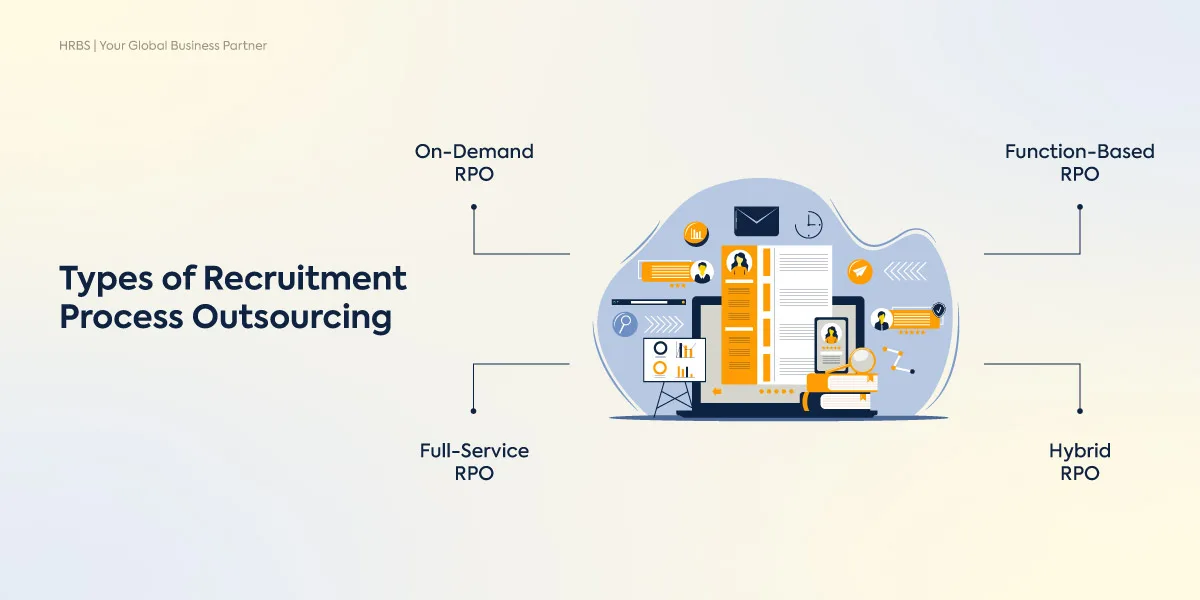
Recruitment Process Outsourcing fits how your business hires. The best setup depends on your total hiring volume, how quickly you need to scale, and the exact roles you must fill.
Before looking at the details, here is a quick overview of the most common RPO models:
| RPO Model | Best For | Commitment Level | Cost Structure |
| On-Demand RPO | Sudden increases in hiring or seasonal busy periods | Low / No long-term contract | Hourly or per-task billing |
| Function-Based RPO | Hard-to-fill, technical, or niche roles | Medium | Retainer or per-hire fee |
| Full-Service RPO | Complete enterprise hiring management | High / Long-term partnership | Management fee + placement fee |
| Project-Based RPO | Market expansions or new office openings | Medium / Fixed timeline | Fixed project fee |
| Hybrid RPO | Dividing regular hires from executive searches | Medium to High | Mixed pricing model |
| Recruiter On-Demand | Filling a temporary list of open roles | Low / Hourly or monthly | Hourly or daily rate |
On-Demand RPO
This model gives you fast hiring support exactly when you need it. Instead of signing a long-term contract, you receive targeted help for exact tasks, such as sourcing candidates or screening resumes. It is a highly scalable option for businesses with changing needs.
- Best For: Companies facing sudden increases in hiring, seasonal busy periods, or opening a new location.
- Core Benefit: You get immediate help without a long commitment. You keep control of the process and only pay for the exact services you use.
- Real-World Example: A logistics company needs to hire 200 delivery drivers for the holiday season. They use On-Demand RPO to screen and interview candidates for just those two months, avoiding the cost of hiring full-time HR staff for a short-term need.
Function-Based RPO
This type focuses on recruiting for highly important or technical roles by using industry experts and professional networks. The RPO team fully understands the skills and cultural fit needed, ensuring better hires for tough positions.
- Best For: Businesses that need to fill technical, niche, or hard-to-find positions.
- Core Benefit: You get access to a larger pool of qualified talent. The recruiters understand the exact job requirements, which leads to better hires and fewer mistakes.
- Real-World Example: A healthcare network uses this model exclusively to hire specialized nurses. The RPO provider uses established medical talent networks to fill these roles in 30 days instead of the usual 90 days.
Full-Service RPO
The provider manages the complete recruitment lifecycle, from planning through sourcing, screening, interviewing, offering, and onboarding. Acting as an active partner of your workforce team, the RPO ensures standard hiring practices across all roles and locations.
- Best For: Large companies with regular hiring needs or businesses without an internal HR team.
- Core Benefit: It cuts overall recruitment costs and improves legal compliance.
- Real-World Example: A global firm expands its operations into Pakistan. The Full-Service RPO provider handles everything from reaching the local talent pool to managing provincial labor rules, calculating social security, and handling minimum wage details, heavily cutting operational costs while keeping the company legally safe.
Project-Based RPO
This model is built for a set goal with a clear end date. It provides expert support for a set period, such as a product launch or a new office opening. Once the project is done, the service ends.
- Best For: Companies entering new markets or needing to fill a set number of roles in a short time.
- Core Benefit: You get expert support to handle a high volume of hiring without adding permanent HR staff. It is fast, cost-effective, and carries no long-term obligation.
- Real-World Example: A technology brand uses Project-Based RPO to hire 50 software developers and 5 managers for a new research facility. Once the facility is fully staffed after four months, the contract ends.
Hybrid RPO
This is a partnership where you divide the work. Your internal HR team keeps control of core hires and company culture, while the RPO provider handles high-volume or routine roles.
- Best For: Growing companies that want to test outsourcing or need help with volume but want to keep key decisions in-house.
- Core Benefit: Your internal team directs attention to leadership roles, while the provider handles time-consuming tasks. This reduces delays and improves candidate quality.
- Real-World Example: A national bank outsources the hiring of its customer service call center agents to an RPO provider, but keeps the hiring of its Chief Financial Officer and branch managers strictly in-house.
Recruiter On-Demand
This allows you to add a skilled recruiter to your team temporarily. It is like hiring an expert for a short time who uses your current system to help fill a list of open roles.
- Best For: Teams that are understaffed, facing a temporary busy period, or need a certain skill set for a few months.
- Core Benefit: You get quick access to a recruiter who knows your industry and uses your existing tools. It scales easily and is cost-effective because you only pay for the time you need.
- Real-World Example: A startup brings in a specialized tech recruiter for three months to help fill five core engineering roles during a new software launch, avoiding the cost of a full-time internal recruiter.
Core Benefits of Recruitment Process Outsourcing (RPO)
RPO companies bring niche skills in talent acquisition. Their strategies help you build a stronger workforce while streamlining operations. Here are the main benefits of using an RPO partner:
- Lower Recruitment Costs: By cutting job board fees and reducing the need for internal recruiters, companies lower hiring costs. An RPO also secures your budget by managing strict compliance, avoiding costly fines tied to local labor rules.
- Access to Top-Tier Talent: Instead of waiting for applications, RPO teams build large talent pools of active and passive candidates. They know how to reach highly skilled professionals across multiple sectors, ensuring every new hire is a strong cultural fit.
- Faster Hiring Speed: Open roles cost money. RPOs use modern sourcing tools to cut the time it takes to finalize a hire. Hard-to-staff roles that usually remain open for long periods are closed much faster through dedicated attention and specialized networks.
- Easy Scalability: Your business needs change throughout the year. An RPO model allows you to increase hiring efforts during busy seasons and scale back during slower periods. You can adjust resources quickly without committing to permanent HR staff.
- Better Candidate Experience: A slow, confusing interview process damages your company reputation. RPOs manage professional communication, send fast updates, and organize the onboarding steps. A positive experience leads to more accepted job offers and lower turnover rates.
- Data-Driven Decisions: An RPO partner tracks core metrics to measure success. Regular reports give business leaders clear insights to improve future hiring steps, ensuring every decision is based on actual performance data.
- Safe Global Expansion: Moving into new markets requires strict compliance with local labor laws. RPO providers manage regional rules, language differences, and cultural norms. This allows you to set up operations in new regions, handling contract requirements and calculating social security, to lower operational costs without legal risks.
How Much Does An RPO Cost?
The cost of Recruitment Process Outsourcing depends on your total hiring volume, the specific roles you need to fill, and the exact services you require. There is no single fixed price; costs are built around your business goals, making it possible for companies of all sizes to find a setup that fits their budget.
Here is a quick breakdown of the most common RPO pricing structures:
| Pricing Model | How It Works | Best Used For |
| Cost-Per-Hire | A set fee paid for each successful hire. | Predictable hiring volumes and clear job roles. |
| Fixed Monthly Fee | A flat retainer paid for ongoing recruitment support. | Steady, long-term hiring needs. |
| Hourly Rate | Paying directly for the recruiter’s time. | Short-term projects or highly specialized roles. |
| Mixed Pricing | A base monthly fee combined with per-hire bonuses. | Changing seasonal demands. |
| Shared Risk / Reward | Fees tied to performance metrics (like retention). | Long-term, high-value placements. |
5 Common RPO Pricing Models Explained
Understanding these standard pricing structures helps you choose the most cost-effective setup for your exact hiring budget.
Cost-Per-Hire: You pay a set amount for each person hired through the RPO provider. This model offers low risk because you only pay for actual results, making it highly transparent. However, it can become expensive if your hiring needs suddenly increase, as costs scale up linearly with every new worker.
- Example: A manufacturing company needing 50 factory workers each quarter pays a fixed amount per new hire. Costs go up or down with actual volume.
Fixed Monthly Fee: You pay a regular, predictable amount for ongoing recruitment support, no matter how many people you hire. This provides budget stability and offers a lower average cost-per-hire during large hiring drives. The risk is that you pay the exact same amount even during slow months when hiring drops.
- Example: A tech firm pays a monthly retainer to cover all its engineering recruitment for a year, making budgeting simple.
Cost Per Hour: You pay directly for the recruiter’s time and effort. This works well for short-term or project-based needs. This gives you full control to pause or scale back hours instantly, keeping short-term costs low. If a role takes a long time to fill due to tough market conditions, the hourly fees can increase quickly without a guaranteed placement.
- Example: A healthcare startup opening in a new city pays hourly for a recruiter to screen nurses and doctors during a three-month project.
Combined Pricing: Some providers let you combine options to match your changing needs. This is the most balanced approach. It protects your cash flow by giving you a low baseline monthly fee while allowing you to handle sudden staff demands safely.
- Example: A retail chain pays a monthly fee for core hiring support but adds a per-hire fee during peak holiday seasons to handle extra temporary staff.
Shared Risk/Reward: A few providers offer performance-based models, where part of the payment depends on hiring outcomes. This perfectly aligns the RPO team’s goals with your business growth, as they only get their full bonus if the worker stays and performs well. The main challenge is that the initial setup requires complex agreements and clear metrics to define success.
- Example: A logistics company agrees to a lower base fee but pays a bonus if the new hire stays with the company for at least six months.
Factors Affecting RPO Cost
Understanding what drives your final quote helps you make smarter business decisions. The total cost of an RPO partnership changes based on:
- Hiring Volume: The more positions you need to fill, the lower the cost per hire can be due to economies of scale. A company hiring 100 warehouse staff will pay less per candidate than one hiring five senior developers.
- Role Complexity:Hiring for specialists, executives, or niche roles costs more than standard positions because they require thorough searches and intense evaluation.
- Services Requested: A complete setup including sourcing, screening, interviewing, onboarding, and ongoing analytics, costs more than sourcing-only support. The broader the service, the higher the price.
- Market Location: Costs change based on local labor markets, compliance rules, and the cost of living. Hiring across international borders, such as setting up a team in the UAE or Pakistan, involves regional rules that impact the final price.
- Provider Experience: Established RPO teams with strong track records of quality and strict compliance often charge higher fees, but they deliver faster placements and long-term savings.
- Modern Tools and Software: Providers investing in advanced screening software or AI-driven sourcing systems include these costs in their pricing, but they use them to deliver faster, higher-quality results.
- Compliance and Reporting: If your company needs deep compliance tracking, detailed background checks, or complex reporting, expect extra costs. This ensures greater transparency and keeps your business legally safe.
When Should a Company Consider RPO?
Recruitment Process Outsourcing is a practical option when your company needs to hire more efficiently than you can manage on your own. Here are clear situations where RPO makes sense:
- Rapid Hiring Needs: If your business is growing quickly, launching new projects, or facing seasonal demand, RPO providers can fill roles much faster than most internal teams. They use established networks, proven sourcing tools, and hiring processes to deliver qualified candidates on schedule, helping you avoid missed deadlines and lost opportunities.
- Limited Internal HR Capacity: When daily HR tasks leave little time for proactive recruiting, RPO takes over candidate sourcing, screening, and onboarding. This lets your internal team focus on employee experience, retention, and strategy while the provider manages the hiring workload.
- Low Hiring Quality: If you’re seeing frequent turnover or too many hires who don’t fit, RPO introduces disciplined screening, structured interviews, and skills assessments. Providers apply consistent, evidence-based methods to reduce mis-hires, lower turnover, and improve team performance.
- High Recruitment Costs: Internal hiring often means hidden costs—recruiter salaries, job board fees, and inefficiencies. RPO streamlines the process, uses technology to cut waste, and offers flexible pricing, leading to measurable savings for many companies. Businesses typically save 20–40% on hiring expenses while maintaining or improving talent quality.
- Expanding into New Markets: Expanding into new regions brings local compliance, language, and cultural challenges. RPO providers manage these complexities, source candidates with the right skills and fit, and keep hiring compliant with local laws, speeding up global expansion.
Improving Employer Brand: RPO provider enhance your employer brand by delivering professional, transparent communication and smooth onboarding. A better candidate experience increases offer acceptance, reduces early turnover, and builds a positive reputation with prospective hires.
How To Choose An RPO Service Provider?
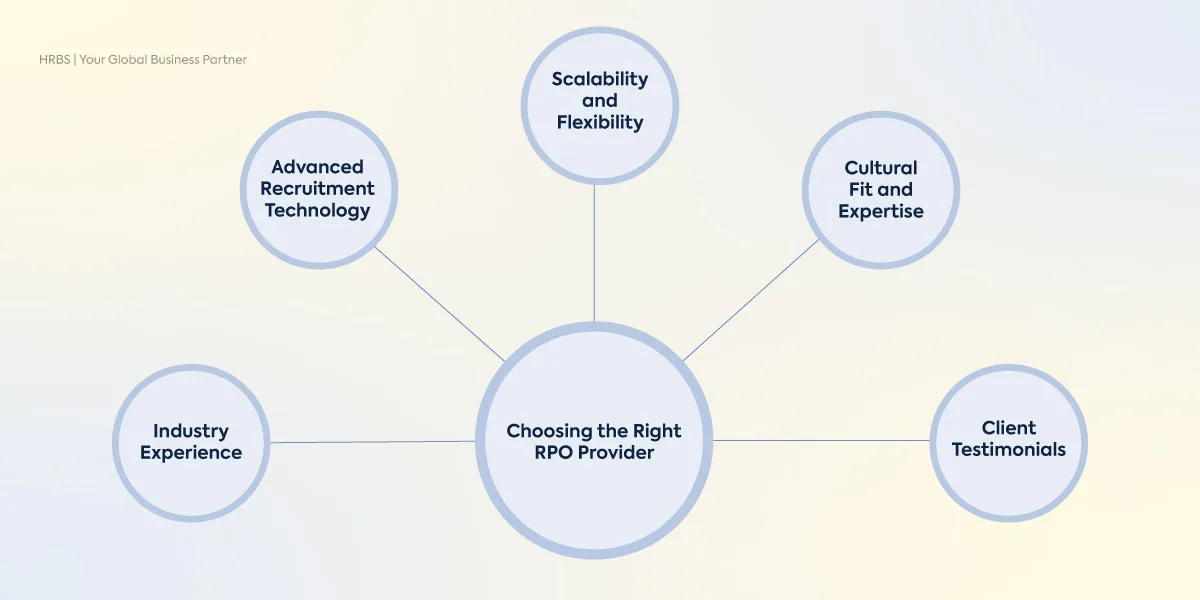
Selecting the right Recruitment Process Outsourcing provider is critical for your hiring success. The right partner acts as an extension of your HR team, streamlining recruitment, improving candidate quality, and reducing costs. Here are the key factors to evaluate when choosing an RPO provider:
- Industry Experience and Expertise: Choose an RPO provider with deep knowledge of your industry’s hiring challenges, skill demands, and compliance rules. Providers specialized in your sector understand where to find qualified candidates and how to navigate market trends. This expertise speeds up hiring and improves long-term retention. Review case studies and client testimonials to verify their track record in your industry.
- Performance Metrics: Evaluate providers based on measurable results such as time-to-fill, cost-per-hire, quality-of-hire, and candidate retention rates. An effective RPO partner shares transparent data and demonstrates continuous improvement. Ask for references and success stories that show how they have lowered recruitment costs and improved hiring speed for similar companies.
- Transparent Pricing and ROI: Discuss pricing models upfront and ensure they align with your budget and hiring goals. The provider should demonstrate clear return on investment through improved hiring speed, quality, and cost savings. Avoid hidden fees and unclear contract terms.
- Compliance and Risk Management: Ensure the RPO provider has expertise in local and global hiring regulations relevant to your business. They should follow ethical recruitment practices, maintain data privacy, and manage legal risks. Strong compliance reduces costly penalties and protects your company’s reputation.
- Client References and Reviews: Research client feedback, online reviews, and industry awards. Reliable providers have positive testimonials highlighting their ability to deliver results, improve hiring quality, and enhance employer branding. Case studies provide insight into their approach and success with businesses like yours.
RPO vs. Other Recruitment Models
RPO offers a scalable, data-driven hiring solution, unlike traditional methods. It enhances efficiency, reduces costs, and improves talent quality, making it ideal for long-term recruitment needs.
| Aspect | RPO | In-House Recruitment | Recruitment Agencies |
| Cost | Predictable, long-term savings.pay for services and results. | Higher fixed costs for salaries, tools, and overhead. Budget can rise quickly with hiring spikes. | Fees per hire can add up, especially for high-volume or repeat hiring. |
| Scalability | Quickly adjust hiring volume up or down without internal staff. | Limited by HR team size, scaling requires hiring more recruiters, which is slow and costly. | Can increase placements but is less flexible than RPO for sudden or large-scale shifts. |
| Expertise | Access to specialized recruiters with broad networks & industry knowledge. | Depends on your team’s skills and training. May lack depth for technical or global roles. | Varies by agency; some have specialists, but scope is usually limited to a region or role type. |
| Technology | Providers use best-in-class sourcing, screening, and analytics tools. | Requires purchase and maintenance of separate HR tech, which can be expensive and complex. | Most agencies lack advanced, integrated recruiting technology; tools vary widely. |
| Employer Branding | Delivers a professional, consistent candidate experience. | Full control over messaging and process, but can be inconsistent without internal expertise. | Limited control; candidate experience is shaped by the agency, not your company. |
Future Trends in RPO: Shaping the Future of Talent Acquisition
Recruitment Process Outsourcing (RPO) is evolving rapidly, driven by technology, changing workforce dynamics, and global business needs. Understanding these trends helps companies stay competitive and build stronger talent pipelines. Here are the key trends shaping RPO’s future:
- AI and Automation: RPO providers use AI to automate repetitive tasks like resume screening, interview scheduling, and initial candidate assessments. This reduces human error and speeds up the hiring process significantly. AI also helps identify hidden skills and potential in candidates by analyzing patterns beyond keywords. As a result, recruiters spend more time engaging with top talent and making better hiring decisions, which leads to higher-quality hires and lower turnover.
- Diversity, Equity, and Inclusion (DEI): RPO partners design recruitment strategies that actively reach underrepresented groups and remove bias from job descriptions, screening, and interviews. They use blind screening tools and structured interviews to ensure fairness. This approach not only improves workforce diversity but also enhances creativity, problem-solving, and employee satisfaction. Companies with strong DEI practices also attract a wider range of candidates and improve their reputation as inclusive employers.
- Global Talent Access: RPO providers help companies hire talent globally while managing complex local laws, tax regulations, and work permits. They offer expertise in cultural differences and language nuances to ensure smooth onboarding and integration. This global reach allows businesses to fill skill gaps quickly and build diverse, agile teams that can operate across time zones. It also reduces legal risks and ensures compliance with labor standards in each country.
- Improved Candidate Experience: RPO providers use chatbots, mobile-friendly platforms, and virtual interviews to keep candidates informed and engaged at every step. Automated updates and easy scheduling reduce candidate frustration and dropouts. Personalizing communication based on candidate preferences improves satisfaction and increases the likelihood of offer acceptance. A positive candidate experience strengthens employer branding and encourages referrals, helping companies attract top talent continuously.
- HR Outsourcing Solutions: RPO is being integrated with HR outsourcing services to provide comprehensive talent management solutions. This integration allows businesses to manage all aspects of their workforce, from recruitment to employee development and retention, through a single, cohesive strategy.
How HRBS Can Help with Recruitment Process Outsourcing?
At HR Business Solutions (HRBS), we help businesses cut hiring costs, secure top talent, manage complex provincial labor laws, and scale recruitment efforts without adding permanent HR staff. Partnering with us gives you an active partner dedicated to reducing overhead and keeping your operations legally safe. Backed by over 7 years of expertise across Pakistan and global markets, we manage the daily recruitment workload so your leadership can direct its full attention to business growth.
- Fast and Accurate Hiring: We deliver your first batch of highly qualified candidates in just three days. Our strict screening reduces bad hires and cuts turnover, ensuring you get dependable talent for both standard roles and executive positions.
- Full Process Management: We take over the entire recruitment cycle—from job postings and talent sourcing to interview scheduling and offer negotiations. This removes daily administrative tasks from your internal department.
- Cost Control and Strict Compliance: Expanding locally or globally means dealing with complex labor laws. We manage statutory deductions, provincial rules, and contract standards to eliminate legal risks while cutting your overall hiring costs.
- Active Ongoing Partnership: We work alongside your business. As your goals change, our processes improve with you, providing regular reports and clear advice to shape future hiring decisions.
- Candidate Experience: We manage all communication, fast updates, and onboarding steps. A highly professional candidate experience improves your company image and leads to more accepted job offers.
Ready to Build a Stronger Team? Get in touch with us to discuss how our services can cut your hiring costs and secure the exact talent you need to succeed.
FAQ’s
What is Recruitment Process Outsourcing (RPO)?
Recruitment Process Outsourcing (RPO) is a flexible hiring solution where a company works with an external provider to manage some or all of its recruitment, from defining requirements and sourcing candidates (including tech roles and executive search) to screening, interviewing, and onboarding. RPO providers act as an extension of your team, using their expertise and recruitment technology to deliver candidates who fit your job needs and company culture. This approach adapts to your business goals, whether you need high-volume hiring, project-based support, or long-term workforce growth.
How does RPO differ from a traditional recruitment agency?
RPO manages your hiring process as a long-term partner, focusing on your recruitment strategy and employer brand, not just filling single positions. Agencies typically charge per hire and have less involvement with your company after the role is filled. RPO provides ongoing support, data-driven improvements, and the flexibility to scale up or down as your hiring demands change, whether for tech, executive positions, or large-scale hiring.
What services do RPO providers offer?
RPO covers a wide range of recruitment services, including job briefings, candidate sourcing (including passive candidates and international talent), in-depth screening and interviewing, interview scheduling, offer management, onboarding, and compliance tracking. Providers also monitor key hiring metrics, support diversity and inclusion, and help with workforce planning, all tailored to your business, whether you need support for niche tech roles, executive search, or broad-scale hiring.
How does RPO help reduce hiring costs and improve efficiency?
RPO cuts hiring costs by minimizing in-house recruiter expenses, reducing agency fees, and streamlining hiring with up-to-date technology and best practices. It improves efficiency by speeding up hiring, lowering early turnover through better candidate matching, and allowing your internal HR team to focus on strategic priorities instead of day-to-day administration.
Is RPO suitable for small and mid-sized businesses?
Yes, RPO can be tailored for businesses of all sizes. Flexible models, such as on-demand or hybrid rpo, let smaller companies access expert recruitment support only when needed, without long-term commitments. This helps manage costs, accelerate hiring for growth, and find qualified candidates, including for specialized or executive roles, without overburdening limited internal resources.
Can RPO providers support large-scale hiring for international expansion?
Absolutely. RPO providers handle international hiring by sourcing local and global candidates, managing compliance with regional labor laws, and addressing language and cultural differences. They also provide market-specific hiring expertise, helping you navigate legal and cultural challenges essential for tech talent, executive hires, and building diverse, effective teams across borders.
How does RPO improve diversity and inclusion in the hiring process?
RPO supports diversity and inclusion goals by broadening candidate searches, using unbiased screening criteria, and tapping into diverse talent pools, including underrepresented groups and international candidates. Providers track hiring metrics, apply assessments, and deliver ongoing reporting.