Hiring in Pakistan offers access to a skilled workforce. However, managing employee benefits and compensation is complex for employers unfamiliar with labor laws and regional compliance. Unlike countries with a single national framework, Pakistan uses federal and regional programs like EOBI and Social Security. This makes benefits administration a technical task. These regulations often challenge company growth.
This guide outlines mandatory and optional employee benefits in Pakistan to help you hire legally and cost-effectively. It covers:
- Statutory Protections: Managing Gratuity, Provident Funds, and Social Security.
- Wage Standards: Structuring basic pay, mandatory leave, and regional requirements.
- EOBI Compliance: Handling contributions and pension requirements.
- Retention: Using health insurance and additional perks to keep staff.
Understanding these regulations ensures legal adherence and helps build a productive work environment that retains talent.
What are Employee Benefits in Pakistan?
Employee benefits in Pakistan are the non-wage perks provided alongside a standard salary to maximize a total rewards package. These offerings secure staff financial stability and well-being while ensuring full statutory compliance with regional labor laws. Implementing a competitive compensation structure builds an engaged workforce, improves talent retention, and increases operational productivity. When organizing local payroll, employers must manage two main types:
- Mandatory Benefits involve legal requirements for every employer to maintain compliance. This includes old-age pension through EOBI, social security through SESSI or PESSI, and Gratuity payments. Employers provide paid annual leave, sick leave, maternity leave, and coverage for workplace injuries. These benefits support staff during illness or childbirth to ensure a basic safety net.
- Voluntary Benefits are perks aimed at satisfaction and retention. Private health insurance, provident funds, wellness programs, and performance bonuses help a business stand out. This helps hire skilled talent in a competitive market while building employer reputation.
Why Employee Benefits Matter in Pakistan?
Employee benefits are not just a legal obligation in Pakistan, they maintain a competitive and productive business. Prioritizing both mandatory and supplementary benefits helps companies stand out in a competitive labor market. This approach reduces financial risk and secures the talent needed for long-term growth.
- Reduce Turnover: Providing benefits increases job satisfaction, which limits people leaving. This saves companies costs related to recruiting, hiring, and training new individuals. Retention remains necessary for operations across sectors like IT, manufacturing, and services.
- Attract Talent: In a competitive labor market, companies that offer health insurance and retirement plans stand out to professionals. These perks show that a company values wellbeing and long-term security, making it more attractive to job seekers—especially in high-growth industries.
- Ensure Compliance: Meeting legal requirements is not optional. Companies that follow rules for mandatory leave, social security, and pension avoid fines, legal disputes, and reputational damage. Staying compliant also prevents disruptions and supports business stability.
- Workplace Engagement: When employees feel supported through benefits, they develop a sense of ownership. This leads to a positive workplace culture and teamwork, providing higher productivity that impacts business performance.
- Improve Mental Performance: Financial security and medical coverage reduce personal stress. This allows the workforce to stay on track with professional tasks rather than managing health or financial issues, which leads to consistent output.
- Tax Efficiency: Structured benefits allow companies to manage payroll costs while increasing net take-home pay. This approach provides financial value to employees without increasing the gross salary expense, making it a way to scale the workforce.
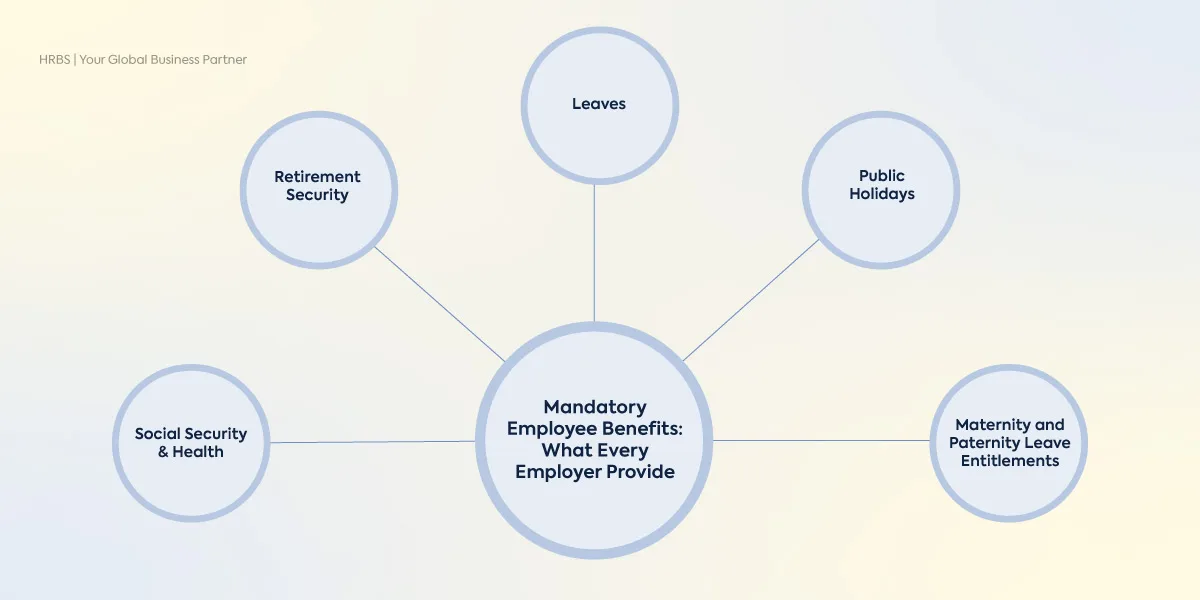
Mandatory Employee Benefits in Pakistan
Employers in Pakistan must comply with specific mandatory employee benefits as defined by labor laws to protect workers’ rights and ensure operational compliance. These benefits cover wages, working hours, leave entitlements, social security, and compensation, directly impacting employee well-being, retention, and business success.
Social Security
Employers must register eligible employees with the Employees’ Social Security Institution (ESSI). This provides workers with access to medical treatment, sickness/injury benefits, maternity benefits, disability coverage, and survivor pensions—directly supporting both employees and their families during critical life events. Non-registration is illegal and exposes employers to fines and penalties.
EOBI
EOBI is a mandatory national pension scheme. Employers contribute 5% and employees contribute 1% (each calculated on the minimum wage) to this fund. EOBI ensures a retirement pension, invalidity pension, and survivor pension for eligible workers, providing a foundation for old-age financial security. Both employer and employee contributions are legally required.
Minimum Wage
All employees, regardless of sector or province, must be paid at least the legally mandated minimum wage. As of 2025, this ranges approximately from 35,000 PKR/month in Punjab to 37,000 PKR/month in Sindh, reflecting local economic conditions. Non-compliance can result in fines, legal action, and reputational damage.
Pension
All eligible employees in Pakistan must be registered with the Employees’ Old-Age Benefits Institution (EOBI). Employers and employees both contribute a set amount each month. At retirement (age 60 for men, 55 for women), employees receive a monthly, lifelong pension, helping ensure basic financial security after work.
Working Hours and Overtime
Pakistani law sets a maximum 48-hour workweek (typically 8–9 hours/day, six days a week). Overtime is strictly limited to 12 hours/week and 3 hours/day, with compensation at 200% of the regular wage for ordinary days and 300% on holidays. These limits are enforced to prevent overwork and ensure fair compensation.
Paid Annual Leave
After 12 months of continuous service, employees are generally entitled to 14 consecutive days of paid annual leave. This supports mental and physical health, reduces burnout, and is a non-negotiable right under labor law. Leave records must be maintained by employers.
Public Holidays
Employees must receive paid leave on all government-declared national and religious holidays (typically 11–15 days/year). If required to work on a holiday, employees are entitled to substitute leave or overtime pay. Respecting these holidays is not just a legal obligation but also a cultural expectation.
Sick Leave
Workers are entitled to 10–16 days of paid sick leave per year (exact amount varies by sector), with medical certification required for extended absences. ESSI-registered employees also receive extended sickness benefits and medical coverage for both occupational and non-occupational illnesses.
Maternity Leave
The Maternity and Paternity Leave Act 2020 entitles female employees to paid maternity leave based on childbirth order:
- 180 days for the first child
- 120 days for the second child
- 90 days for the third child
Insured female employees who have contributed for at least 180 days in the previous year receive full wage compensation during maternity leave.
Paternity Leave
Male employees qualify for 30 days of paid paternity leave for the first three childbirths. This benefit supports family bonding and promotes gender-inclusive workplace policies, enhancing employer branding.
Casual Leave
Pakistani law requires employers to provide up to 10 days of paid casual leave per year for personal or family emergencies. This leave is separate from annual or sick leave. Rules for using it (such as prior approval, notice, and documentation) may vary by employer.
Termination and Severance Pay
Employees must receive advance written notice (usually 30 days) before termination. If terminated for reasons other than misconduct, they get severance pay (30 days’ wage per year of service).
Non-Mandatory Employee Benefits in Pakistan
Beyond what is legally required, many Pakistani employers choose to offer additional benefits as part of their compensation strategy to attract top talent, increase retention, and enhance employee satisfaction and productivity. These benefits are voluntary, not mandated by law, but play a crucial role in building a positive workplace culture and a competitive employer brand.
- 13th-Month Pay/Bonus: A common practice among larger organizations is to award employees with an extra month’s salary or a discretionary annual bonus. This is paid at year-end and serves as both a financial reward and a retention tool.
- Provident Fund: While EOBI is the mandatory pension scheme, some employers contribute to a provident fund where both the company and the employee make voluntary contributions. These savings provide additional financial security for employees after retirement.
- Health Insurance: Employers often offer private health insurance coverage, sometimes extending it to immediate family members. This benefit is highly valued as it reduces employees’ out-of-pocket medical expenses and supports overall well-being.
- Life Insurance: The employer pays for an insurance policy that gives money to the employee’s family if something unexpected happens to the employee. This helps protect the family’s financial future and gives employees peace of mind.
- Profit and Performance Bonuses: Profitable companies sometimes allocate a portion of annual profits to be distributed among employees, rewarding collective effort and success.
- Voluntary Pension Fund (VPF): Employees can join SECP-regulated pension schemes beyond mandatory EOBI. They or their employer can contribute flexible amounts, enabling more retirement savings for long-term security.
- Trainig and Development: Investing in employee growth through skills training, certifications, and leadership programs helps build a capable workforce and supports career progression.
- Travel Allowance: Travel allowance is an optional benefit some employers in Pakistan offer to cover or reimburse expenses employees incur while traveling for work, such as commuting between locations, client visits, or business trips.
- Meal Allowance: Some employers provide a meal stipend or on-site canteen facilities, reducing daily expenses for employees and supporting their convenience.
- Mobile Phone Allowance: A monthly stipend or company-provided device helps employees stay connected for work-related communication, especially important for hybrid or remote roles.
Workers’ Compensation and Death Benefits
If a worker is injured on the job, Pakistani law requires employers to cover all medical costs and provide compensation for lost wages during recovery. If an employee dies because of a work-related incident, specific benefits are paid to the family to provide immediate and ongoing support.
- Death Grants: A one-time payment equal to 30 days’ wages (with a legally set minimum amount) is given to the family when a worker dies due to a workplace accident, offering quick financial help during a difficult time.
- Survivor Pension: Dependents, such as a widow and children receive a regular survivor pension. This continues until the widow remarries or the children reach adulthood (usually age 18), helping the family maintain financial stability.
- Funeral Expenses Grant: The employer or social security institution pays for funeral costs, calculated as 30 times the daily sickness rate (with a minimum amount set by law), ensuring a respectful burial.
Iddat Benefits: Pakistani law provides paid Iddat leave, about 4 months and 10 days for widowed female employees, honoring cultural and religious traditions while protecting their income during mourning.
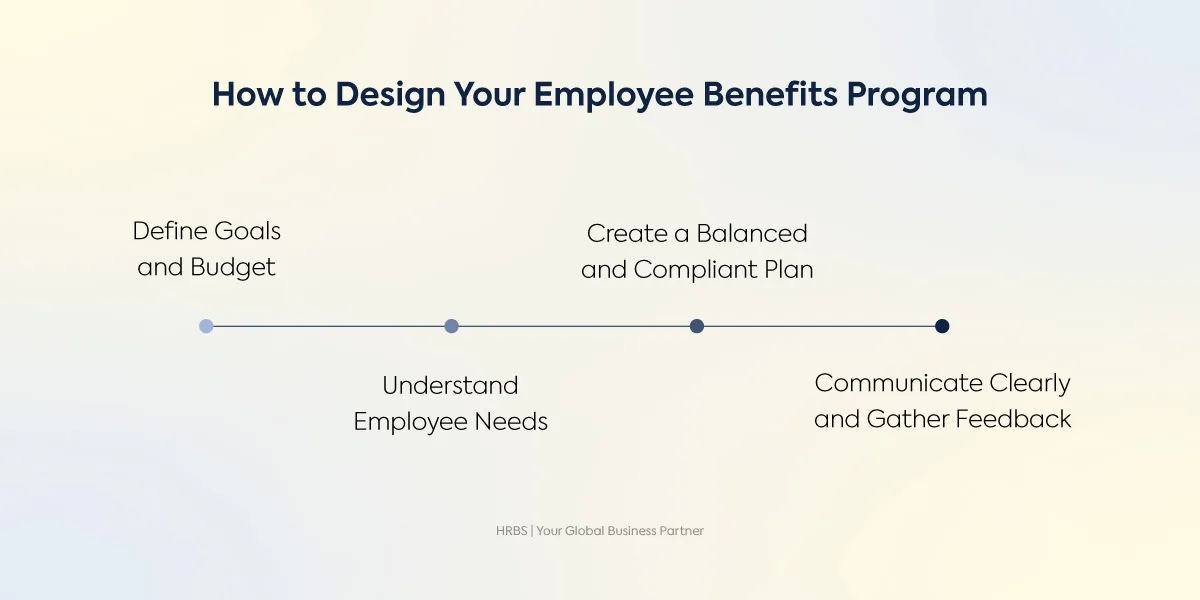
How to Design Employee Benefits Program in Pakistan?
A well-structured benefits program helps you attract and retain talent, control costs, and avoid legal penalties. Follow these clear steps to build a compensation plan that fits your business needs and satisfies employees while ensuring compliance with labor laws:
Step 1: Define Goals and Budget
Start by clearly outlining your business objectives—such as attracting talent, reducing turnover, and meeting legal standards like minimum wage and mandatory benefits. Assess your company’s budget to allocate funds for salaries, allowances, and compulsory benefits without compromising profitability. Review existing employment contracts and agreements to avoid legal conflicts.
Step 2: Understand Employee Needs
Conduct employee surveys or focus groups to identify which benefits matter most, such as health insurance, provident fund, or paid leave. Compare your current offerings with industry and regional benchmarks to ensure your package remains competitive in Pakistan’s job market.
Step 3: Design the Compensation Structure
Establish a mix of fixed pay (basic salary, allowances) and variable pay (bonuses, annual increments). Integrate all legally required benefits, social security, EOBI, paid leave, and consider voluntary perks like medical coverage or flexible retirement plans. Customizable options help increase engagement and control costs.
Compensation Structure = Fixed Pay + Variable Pay + Mandatory Benefits + Voluntary Benefits
Step 4: Communicate and Collect Feedback
Clearly communicate the benefits plan to all employees, emphasizing both mandatory and optional components. Gather feedback regularly to identify any underused or low-value benefits. Make necessary adjustments based on this feedback to boost satisfaction and effectiveness.
Step 5: Review and Update Annually
Review your benefits plan at least once a year to ensure ongoing compliance with updated labor laws and regulations. Monitor key indicators such as employee retention, payroll costs, and satisfaction surveys. Use these insights to refine your program and maintain its relevance and competitiveness.
How to Calculate Employee Benefits in Pakistan?
Calculating employee benefits in Pakistan requires understanding both statutory requirements and the processes for each benefit. Here is a clear, step-by-step guide for employers and employees, focused on accuracy and compliance.
Calculate the Statutory Pension (EOBI)
The Employees’ Old-Age Benefits Institution (EOBI) contribution is a monthly fee determined by the current minimum wage. For the Tax Year 2026, where the minimum wage in Punjab, Sindh, and KPK is PKR 40,000, the calculation is clear:
- Employer Share: 5% of the minimum wage (PKR 2,000)
- Employee Share: 1% of the minimum wage (PKR 400)
Calculate Social Security Contributions
Provincial social security provides medical and injury cover for the workforce. This is an employer-funded cost calculated as a percentage of the salary, often capped at the minimum wage level for contribution purposes:
- Employer Contribution: 6% of the wage (e.g., PKR 2,400 for a person earning the minimum wage).
- Benefit: This provides the workforce with access to health facilities and maternity support.
Calculate End-of-Service Gratuity
Pakistan law ensures that employees who complete at least one year of work get a gratuity payment upon leaving. To calculate this liability:
- Formula: One month’s gross salary for every completed year of service.
- Monthly Accrual: To budget for this, set aside 8.33% of the gross monthly salary (Gross Salary / 12).
Calculate Annual Leave and Holidays
Law ensures every individual earns at least 14 days of paid annual leave after 12 months of work. To calculate the cost of leave encashment:
- Encashment Value: (Gross Monthly Salary / 26) x Number of Unused Days.
- Public Holidays: There are typically 10 to 14 official public holidays per year that must be paid in full.
Cost Overview: Full-Time Salary Example
If you hire a professional at a monthly salary of PKR 100,000, here is how your budget looks:
| Component | Monthly Cost (PKR) |
| Gross Salary | 100,000 |
| EOBI (Employer Portion) | 2,000 |
| Social Security (Estimated 6%) | 2,400 |
| Gratuity Accrual (8.33%) | 8,333 |
| Total Monthly Investment | 112,733 |
Financial Implications of Employee Benefits in Pakistan
Mandatory employee benefits in Pakistan carry direct tax and cost implications for both employers and employees, proper calculation, withholding, and reporting are essential for legal compliance and financial accuracy.
Taxation as Earned Income
Benefits such as company cars and utility allowances are added to gross pay and taxed according to the personal income bracket. The Federal Board of Revenue (FBR) treats these as non-monetary gains that increase total taxable income. For the Tax Year 2026, the exemption threshold remains at PKR 600,000, with rates rising to 35% for high earners.
Labor Market Contribution
Mandatory deductions for social security and pension funds apply to the salary of eligible staff. Employers contribute a set percentage of the wage to ensure access to medical and retirement support.
- EOBI: The employer pays 5% of the minimum wage (PKR 2,000), while the individual pays 1% (PKR 400).
- Social Security: Provincial bodies like PESSI or SESSI typically require an employer-only contribution of 6% to fund healthcare and injury coverage.
Communication Allowances
Costs for mobile phones and internet are generally tax-free if used for business purposes. Still, allowances provided for personal use are added to the taxable salary total. Proper documentation of business usage can help firms provide these perks without increasing the tax burden on the workforce.
Exempt Allowances and Relief
Specific allowances provide a financial advantage without raising tax liability:
- Medical Allowance: Exempt up to 10% of the basic salary if the firm does not offer separate medical reimbursement.
- Pension Funds: Contributions to approved funds allow for tax credits, reducing the final tax payable for individuals.
- Gratuity: Payments from a qualified gratuity fund are often exempt from tax under the Second Schedule of the Income Tax Ordinance.
Active Taxpayer Advantage
Individuals on the Active Taxpayer List (ATL) access lower withholding tax rates on financial transactions. Being a “filer” reduces the tax on bank withdrawals, vehicle acquisitions, and property transfers compared to the rates for non-filers. Firms that help their staff maintain filer status provide a hidden financial benefit that increases purchasing power.
Direct Tax Deductions and Compliance
Employers act as withholding agents to take the correct amount of tax before payment. This ensures that the final amount people get is the actual net pay, while the firm handles the monthly deposit to the government.
- Monthly Filing: Firms must submit statements through the IRIS portal by the 15th of each month.
- Audit Risk: Maintaining detailed records of all perks and deductions is necessary to prevent penalties during FBR or provincial audits.
| Item | Responsible Party | Rate (Tax Year 2026) | Financial Impact | Action Required |
| Income Tax | Employee | 0% to 35% (Progressive) | Applied to gross pay plus taxable perks. | Deduct at source (PAYE); remit to FBR by the 15th. |
| EOBI Pension | Employer & Employee | Employer: 5%; Employee: 1% | Calculated on the minimum wage (e.g., PKR 40,000). | Register staff; pay monthly via EOBI portal. |
| Social Security | Employer | Approx. 6% of Wage | Employer-only cost; provides medical/maternity cover. | Pay to provincial bodies (PESSI/SESSI) monthly. |
| Minimum Wage | Employer | PKR 40,000 (Most Provinces) | Statutory floor for unskilled labor costs. | Ensure no full-time staff earns below this base. |
| Payroll Filings | Employer | N/A | Compliance requirement to avoid fines. | Submit monthly statements via IRIS (FBR) portal. |
| Gratuity / PF | Employer | One month’s pay per year | Long-term liability for end-of-service dues. | Accrue funds annually; pay upon termination/exit. |
What Employees Should Know About Their Benefits?
Employees in Pakistan have legal rights to specific benefits. Understanding these ensures people get their legal dues and helps employers follow the law. Below is an actionable checklist covering what to know, how to qualify, and the steps to take if benefits are denied.
Key Benefits Employees Should Claim
- Maternity and Paternity Leave: Paid time off for expectant mothers is based on the number of children, typically between 90 and 180 days. Progressive firms also offer paid time for fathers to help with family care.
- Medical and Casual Leave: Paid sick leave is available with a medical certificate. People also have a right to 10 days of casual leave for personal or family needs.
- Social Security and Pension: Medical care, disability support, and retirement funds are managed through provincial systems. Both the individual and the firm must contribute to these funds to ensure financial security.
- Workers’ Compensation: This covers medical costs and wage replacement if an injury happens on the job.
- Annual and Holiday Leave: After 12 months of work, people earn 14 days of paid annual leave. Paid time off is also mandatory for all official public holidays.
- Overtime and Bonuses: Extra pay is required for hours worked past the standard 48-hour week. Industrial and commercial firms with 20 or more staff must provide a profit-sharing bonus during profitable years.
Eligibility Requirements
- Employment Status: Regular, full-time status is usually necessary to access full legal protections.
- Service Duration: Completing a probation period of three to six months is often required for permanent status. Annual leave requires 12 months of work without a break in service.
- Official Registration: To receive pension and medical benefits, individuals must be registered with the relevant social security institution.
What if Benefits are Denied?
If a firm does not provide legal benefits, follow these steps to resolve the issue and secure your rights:
- Internal Discussion: Speak with the HR or payroll department to check for errors. Document the date, time, and the person you spoke with.
- Formal Notice: If the issue continues, send a formal written request via registered mail. This creates a record that the firm was notified of the missing benefits.
- Labor Department Complaint: Report the matter to the local labor office. Labor inspectors have the authority to audit company records, interview staff, and enforce immediate payment of arrears.
- Legal Mediation: Many labor offices offer a conciliation phase where an officer helps negotiate a settlement between the employee and employer without going to court.
- Labor Court Filing: For unpaid dues, wrongful termination, or lack of statutory coverage, file a case in the Labor Court. In Pakistan, these cases must generally be filed within 12 months of the incident to be valid.
Legal Acts and Ordinances Governing Employee Benefits in Pakistan
The Pakistani legal system provides a framework for employee benefits and workplace rights. Understanding these acts helps firms maintain compliance and ensures the workforce receives its dues. Below are the primary acts and the value each provides.
- Workmen’s Compensation Act, 1923: Employers must cover medical costs and pay compensation for workplace injuries, disabilities, or death. Families receive financial support without waiting for long legal disputes, providing a safety net during emergencies.
- Industrial Relations Ordinance (IRO), 2002: Employees have the right to form and join unions and engage in collective bargaining. Employers must negotiate in good faith and follow official procedures to resolve disputes. This framework supports communication between the workforce and management.
- Minimum Wages Ordinance, 1961: Employers must pay at least the minimum wage set by provincial governments. As of early 2026, the monthly wage for unskilled workers in Punjab, Sindh, and KPK is PKR 40,000, while in Islamabad and Balochistan, it is PKR 37,000. This ensures a basic income standard to help staff meet living needs.
- Social Security Ordinance, 1965: Firms must register eligible staff with provincial institutions and make regular contributions. This provides access to medical care, sickness pay, maternity leave, and injury compensation, reducing financial stress during life events.
- Factories Act, 1934: This act regulates working conditions to ensure health and safety. It mandates proper ventilation and provides guidelines for the work environment. It also limits the standard workweek to 48 hours and ensures people receive at least 14 days of paid annual leave after one year of work.
- Payment of Wages Act, 1936: Staff must receive their full wages on time, at least once a month, with no unauthorized deductions. This protects the workforce from payment delays and ensures they receive their earnings as agreed.
Case Studies: Leading Companies’ Benefit Packages in Pakistan
Top employers in Pakistan design their benefits to attract and keep employees while meeting legal standards. The following case studies show how leading firms balance compliance with advantages that improve satisfaction.
Systems Limited
As a global leader in digital services, Systems Limited provides a package built on professional growth and financial security to support its specialized workforce:
- Financial Incentives: Staff are eligible for a share purchase scheme that allows them to buy company stock. Additionally, the firm offers performance-based rewards that exceed the industry standard, ensuring financial security.
- Health and Wellness: To support a healthy lifestyle, employees have access to medical insurance covering out-patient and in-patient needs. The company also offers gym memberships and wellness sessions to reduce workplace stress.
- Work-Life Balance: Beyond the legal requirement, employees receive flexible working hours and remote work options. This ensures enough downtime for high-performing staff.
- Skill Development: For technical experts, the company offers full certification support and training programs to ensure the workforce stays ahead in the global market.
Engro Corporation
As a leading organization in Pakistan, Engro Corporation offers a benefits package designed to prioritize family bonds and build a strong company culture:
- Extended Parental Leave: The company leads the market with generous paid leave for parents. This support applies from the start of employment to help staff manage family responsibilities.
- Educational Support: To reinforce company values, the firm provides scholarships and educational assistance for the children of employees. This unique perk shows the importance of long-term family security.
- Collective Performance Rewards: Bonuses are tied to the collective performance of the business. This supports collaboration and shared success rather than internal competition.
- Hardship Support: Employees are provided with interest-free loans and emergency financial assistance to look after personal needs, ensuring that life events do not compromise financial stability.
How HRBS Can Help with Employee Benefits in Pakistan?
Managing compensation in Pakistan involves navigating labor regulations and social insurance rules. Our team acts as an Employer of Record, handling legal and administrative tasks to maintain compliance without a local entity. By automating payroll and tax withholding, we eliminate errors and save time for your internal team. We manage statutory requirements including the minimum wage, end-of-service gratuity, and mandatory contributions to social insurance bodies, allowing you to hire talent without local overhead.
Our solutions manage the entire hiring process and daily work, allowing you to get people started smoothly without a subsidiary. By managing taxes and leave, we free you to expand operations and reduce legal risks. Speak with our team to secure the best people with a high-value offer that fits your goals.
FAQ’S
What are the statutory employee benefits in Pakistan?
Pakistani law requires employers to provide minimum wage, limited working hours with overtime pay, paid annual leave, public holidays, casual and sick leave, maternity and paternity leave, workers’ compensation for injuries, social security (including medical care, sickness pay, disability, survivor, and funeral grants), and proper notice period, severance pay, and gratuity at termination. These are all legal obligations; failing to provide them can result in fines or legal action.
How does social security work for employees in Pakistan?
Employees registered with the Employees’ Social Security Institution (ESSI) receive access to medical care, paid leave during sickness or injury, maternity benefits, disability coverage, and survivor pensions. Both employer and employee must contribute. This system covers most formal sector workers and is mandatory for eligible employees.
Can employers offer benefits beyond the mandatory requirements?
Yes, employers may offer additional benefits, such as health and life insurance, provident fund, bonuses, training, meal/mobile allowances, and more. These are voluntary, not required by law, and help attract and retain talent.
How do employers calculate overtime pay in Pakistan?
Overtime pay is 200% of the regular wage rate for extra hours on ordinary days, and 300% on holidays. Total weekly overtime is capped at 12 hours. Calculation:
Overtime Pay = (Regular Hourly Wage) × Overtime Hours × (2 or 3)
How are employee benefits treated for tax purposes in Pakistan?
Mandatory benefits such as social security, EOBI, and statutory leave are generally not taxed for employees as long as they are within legal limits, but cash allowances and most voluntary benefits like transport, meal, mobile, and housing allowances are usually taxed as part of regular income and must be reported on the payroll.
How to calculate employee compensation in Pakistan?
Total compensation = Basic pay + legally mandated benefits (social security, EOBI, annual/sick/maternity/paternity leave, public holidays, overtime) + any voluntary benefits (bonus, insurance, allowances). Salary should be at least the minimum wage for the province and sector.
What maternity leave rights do female employees have in Pakistan?
Pakistani law guarantees paid maternity leave of up to 180 days (first child), 120 days (second child), and 90 days (third child). Insured female employees receive full wage compensation during leave after meeting contribution requirements.
How can employers ensure compliance with employee benefits laws in Pakistan?
Employers should:
- Register all eligible employees with ESSI and EOBI
- Pay at least the minimum wage and required overtime
- Provide all legally mandated leave and holidays
- Maintain accurate payroll records
- Stay updated on federal and provincial labor laws
- Communicate benefits clearly to employees
- Report violations promptly to labor authorities
- Respond to employee complaints and audits by provincial labor departments
What benefits are trending for remote or hybrid workers in Pakistan?
Currently, no law in Pakistan requires companies to provide specific benefits for remote or hybrid employees, all offerings depend on employer policy. Flexible work arrangements are increasingly available, including the option to work from home, coworking spaces, or with adjustable hours. Some companies also cover costs for internet, equipment (like laptops or monitors), and mobile data, or provide stipends for setting up a home office.