When hiring workers in Pakistan, understanding employment contracts is a legal requirement to maintain compliance with provincial labor laws and statutory regulations. An employment contract in Pakistan defines the exact terms and conditions of work, establishing legal clarity for both employers and employees. Regulated by regional labor authorities, these agreements set mandatory provisions including weekly working hours, provincial minimum wage rates, statutory benefits like EOBI and gratuity, and probation periods.
Companies choose between permanent and fixed-term contracts, with temporary arrangements matched directly to project timelines. Employers must follow structured steps when creating, executing, or terminating an employment agreement to maintain regulatory compliance. Unlike an offer letter—which gives an early overview of job terms—a formal employment contract carries full legal validity.
In this guide, we cover the contract types, required clauses, employer obligations, and employee rights needed to secure complete legal compliance across Pakistan.
What is an Employment Contract in Pakistan?
An employment contract in Pakistan is an official written agreement between an employer and a worker that establishes clear terms of work. Governed by provincial labor rules, this document defines workplace rights, job duties, and statutory obligations for both parties. A fully compliant document also details compensation structures, secures benefits like EOBI, and guarantees operational alignment across permanent, temporary, and fixed-term roles.
To ensure complete regulatory compliance, a standard agreement must clearly define the following essential details:
- Job Role: Title, primary tasks, and expected duties.
- Compensation: Base wage, payment schedules, and allowances.
- Work Schedule: Daily working hours, rest breaks, and leave policies.
- Statutory Benefits: EOBI registration, social security coverage, and gratuity payments.
- Employment Terms: Probation duration, notice rules, and termination protocols.
Whether a company uses permanent, fixed-term, or temporary hiring arrangements, a documented agreement protects employers and workers while preventing workplace disputes.
Legal Framework Governing Employment Contracts in Pakistan
Following the 18th Constitutional Amendment, provincial governments manage labor laws in Pakistan. The Industrial and Commercial Employment (Standing Orders) Ordinance, 1968, guides workforce management, supported by local provincial acts.
Employers must follow exact guidelines across permanent, temporary, and fixed-term roles. The legal structure outlines these requirements:
- Written Contract Requirement: Under Standing Order 2-A (1968 Ordinance), organizations must issue a written order detailing service terms during appointment, transfer, or promotion. Provincial acts like the Sindh Terms of Employment Act 2015 and the KP Industrial and Commercial Employment Act 2013 replicate this rule.
- Regional Labor Rules: Provinces separately set minimum wage thresholds, work hours, and leave policies. The Sindh Minimum Wages Act 2015 and equivalent laws in Punjab, Balochistan, and KPK define local compensation standards. Multi-region businesses must align agreements with local labor requirements.
- Workplace Regulations: The Factories Act 1934 and the Shops and Establishments Ordinances govern daily shift limits, overtime rates, and occupational safety.
- Statutory Financial Benefits: Employers must register eligible workers with the Employees’ Old-Age Benefits Institution (EOBI Act 1976) for pensions. Companies must also enroll workers in health programs under the Provincial Employees Social Security Ordinance 1965 (managed by SESSI, PESSI, and KPESSI). Provincial standing orders outline post-employment settlements through gratuity calculations or provident funds.
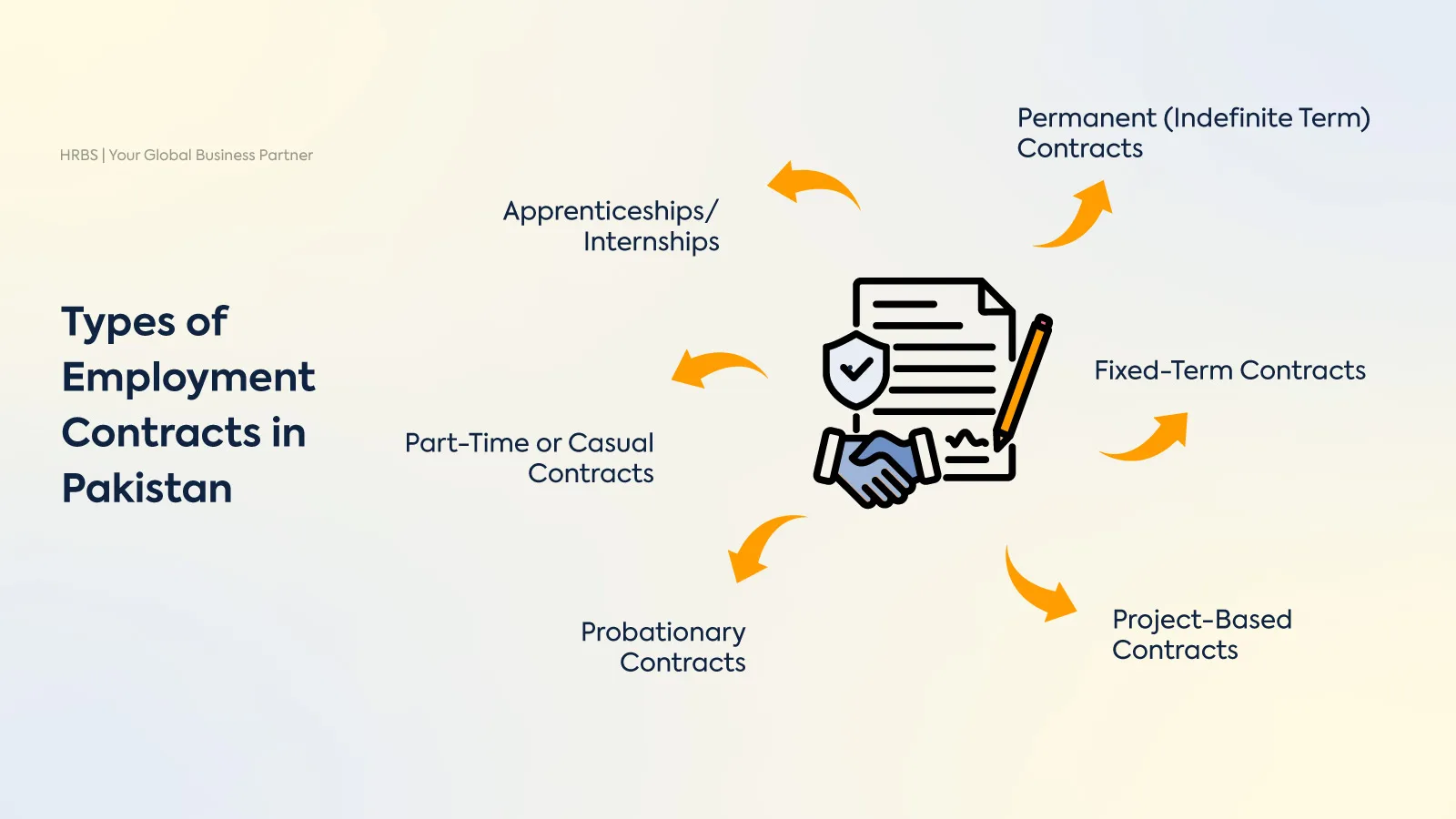
Types of Employment Contracts in Pakistan
Businesses operating in Pakistan must classify workers correctly. Choosing the right agreement protects both the employer and the worker. Here are the employment agreements used:
Permanent Contracts
A permanent contract secures ongoing roles without a fixed end date. This applies to workers performing daily tasks for long-term roles. These agreements provide full benefits, including paid leave, pension registration, health coverage, and gratuity. Employers can only close these agreements by providing a formal notice or payment instead of notice.
Fixed-Term Contracts
Fixed-term contracts apply to roles with a defined start and end date. Companies rely on them for seasonal work, maternity cover, or short-term business needs. Workers under these agreements receive the exact same rights as permanent staff during their working period. The agreement ends on its own once the agreed time comes, without requiring a formal termination notice unless both sides agree to an extension.
Probationary Contracts
A probationary contract provides a trial period to check a new hire’s performance. During this trial timeframe, employers assess suitability for the role. If the employer finds the performance satisfactory, the worker transitions to permanent status. If the performance falls short, the company can close the agreement without advance notice.
Project-Based Contracts
Project-based contracts apply when a company hires workers for a clear assignment, such as a construction job or a software build. The agreement runs only until the project finishes. Employers must clearly write the exact project scope and completion terms in the agreement to avoid disputes once the work concludes.
Part-Time Contracts
Part-time or casual contracts suit roles requiring fewer hours than a normal workweek. Casual workers perform irregular tasks when needed. Compensation usually follows hourly or daily rates matching provincial standards. While part-time staff still qualify for workplace rights, their benefits, such as paid leave, calculate proportionally compared to full-time staff.
Apprenticeships / Internships
Apprenticeship agreements cover individuals receiving formal on-the-job training. Official guidelines frame these arrangements, ensuring trainees receive learning opportunities and a monthly stipend. Internships follow a similar model for recent graduates gaining workplace experience. These agreements outline the exact training timeline and do not guarantee a permanent job offer after completion.
Temporary Contracts
Temporary contracts cover work expected to finish within a short timeframe. If a temporary role continues beyond the short-term limit, official guidelines often require reclassifying the worker as permanent. These agreements help businesses manage short-term workload spikes while ensuring workers receive basic wage rights during their service.
Contract Worker Agreements
Contract worker agreements apply to individuals hired to deliver a clear output, often paid through piece-rate calculations rather than a fixed monthly salary. These workers operate under different terms compared to regular employees. Businesses must clearly define the payment structure and deliverables to ensure compliance with provincial standards.
Essential Clauses in a Pakistani Employment Contract
A written agreement sets clear expectations for both the business and the worker. To avoid disputes and run a smooth workplace, every contract in Pakistan must cover basic terms. Here are the core clauses to include:
- Job Role and Daily Tasks: State the job title and the expected work. This sets boundaries and ensures the worker knows exactly what to do from day one.
- Salary and Payment Schedule: Write down the base pay, any extra allowances, and how often the worker gets paid, such as weekly or monthly. This amount must match or go above the local minimum wage.
- Work Hours and Overtime: Define the standard workweek, daily shift limits, and rest breaks. Also, outline exactly how the company pays for extra hours worked.
- Paid Time Off and Leaves: Detail the exact amount of paid time away a worker gets each year. This covers yearly vacation, sick days, casual time off, and maternity leaves. Explain how workers ask for this time.
- Workplace Benefits: List any extra perks the company provides. This includes health coverage, pension enrollment, and end-of-service payouts.
- Contract End and Notice Period: Explain how either side can close the agreement. Include the required warning time before leaving and outline how final payments work.
- Privacy and Business Secrets: Add rules to stop the worker from sharing private company information, ideas, or client lists during and after their employment.
- Dispute Resolution: Outline the steps both sides will take to handle workplace complaints. Adding an internal review process encourages workers to settle issues directly with management.
A clear, detailed contract minimizes misunderstandings and legal risks. In case of disputes, the written contract serves as primary evidence before labor courts. Always ensure each clause complies with current labor regulations and is written in plain, understandable language.
Employer Obligations Under Employment Contracts in Pakistan
When a business hires a worker, the company takes on clear duties to protect that individual and follow provincial workplace rules. Meeting these duties prevents legal trouble, builds trust, and ensures a smooth daily operation. Here is exactly what an employer must provide and manage during the working relationship:
- Provide a Written Agreement: Companies must give every new hire a clear, written document before work starts. This document must spell out the job title, daily tasks, pay rate, and basic workplace rules so there is zero confusion about the role.
- Guarantee Timely and Fair Pay: The business must pay the agreed salary on a set schedule, such as weekly or monthly. This base pay can never fall below the provincial minimum wage. The company is also responsible for deducting the correct income tax from the salary and sending it directly to the government.
- Contribute to Health and Retirement Funds: Employers cannot just pay a base salary; they must also register workers for basic social protections. This means paying a monthly share into government pension programs and provincial healthcare networks to support the worker’s long-term wellbeing.
- Ensure a Safe Work Environment: The company must keep the physical workplace safe and free from hazards. For physical or factory work, this includes providing the right safety gear, training workers on safe machine operation, and having clear steps for handling workplace accidents.
- Control Work Hours and Pay Overtime: The business must respect the standard workweek limits and ensure workers get regular rest breaks. If the company asks a worker to stay late or work on a rest day, the employer must pay for those extra hours at a higher premium rate, not the standard hourly rate.
- Grant and Track Paid Time Off: Employers must allow workers to take their earned time away from work without penalty. This includes approving yearly vacations, sick days, and maternity leave. The company must keep accurate records of used and available time off.
- Provide Payslips and Clear Records: At the end of every pay cycle, the employer must give the worker a detailed payslip. This document must show the total money earned, any taxes taken out, extra allowances paid, and the final amount deposited into the bank.
- Follow Fair Exit Processes: If the company decides to let a worker go, the employer must provide a clear written notice explaining the exact reason. The business is also responsible for quickly paying out the final salary, any unused vacation days, and end-of-service retirement payouts.
Employee Rights under Pakistani Employment Law
Labor guidelines in Pakistan guarantee basic rights to protect workers from unfair treatment. Even if an employer leaves these out of the written agreement, the law still forces the company to provide them. Here are the core rights every worker holds:
- Fair Minimum Wage: Every worker is entitled to a base monthly salary that meets their province’s minimum threshold. Employers must pay this on a regular schedule without unauthorized deductions. Additionally, newer rules mandate equal pay for work of equal value, strictly prohibiting wage discrimination based on gender or background.
- Work Hours and Overtime: The standard workweek is capped at 48 hours, typically spread over a maximum of nine hours per day. If a business requires a worker to stay late or work on a rest day, the worker has the absolute right to overtime pay, which is calculated at double their standard hourly rate.
- Guaranteed Paid Time Off: Workers earn mandatory time away from work. Depending on the province, employees receive between 14 to 18 days of paid yearly vacation after one year of service. This is on top of separate allowances for personal needs (casual leave) and medical recovery (sick leave).
- Maternity Support: Female workers are entitled to fully paid maternity leave, ranging from 12 to 16 weeks regionally, while federal employees receive up to 180 days. The law secures paid nursing breaks upon return and strictly bans companies from terminating staff due to pregnancy.
- Personal Leaves: Beyond standard vacation, workers have rights to specific situation-based leaves. For example, recent provincial frameworks grant Muslim widows up to 130 days of paid bereavement leave and offer dedicated quarantine leave during public health emergencies.
- Retirement and Healthcare Safety Nets: Workers have the right to basic social support funded by the employer. This includes mandatory enrollment in national pension programs for old-age income and provincial social security networks that provide medical care for the worker and their dependents.
- Safe Workplaces: Every employee deserves a hazard-free workspace and protection against workplace harassment. Workers also hold the right to form or join trade unions, allowing them to negotiate collectively for better conditions without fear of workplace retaliation.
These rights are not just on paper, they are enforceable by law. If your employer fails to meet these standards, you have legal options to protect your job and well-being. Knowing your rights is the first step to ensuring fair and lawful treatment at work.
Common Issues and Disputes in Employment Contracts
Even with a written agreement in place, the relationship between a business and a worker can break down. In Pakistan, workplace disagreements often end up in local labor courts due to poorly drafted contracts or a failure to follow basic provincial guidelines. Understanding the most frequent points of tension helps both sides avoid costly legal action and maintain a productive work environment.
- Verbal Agreements and Unclear Terms: Many disagreements start because the employer never provided a formal appointment letter. When job terms are only agreed upon verbally, businesses struggle to apply workplace rules, and workers face sudden, unfair changes to their pay or daily duties.
- Unfair and Sudden Termination: A major legal conflict involves companies letting workers go without a proper reason or skipping the mandatory notice period. Terminating an employee immediately without an internal review or a documented track record of poor performance often leads to courts ordering the company to rehire the worker with back pay.
- Missing Salaries and Unpaid Overtime: Disagreements frequently appear when businesses fail to pay the legal minimum wage or make unauthorized deductions from a worker’s monthly salary. Additionally, employers often misclassify salaried staff to avoid paying double-rate overtime when those employees are forced to work late or on weekends.
- Misclassification of Job Status: Companies sometimes keep workers on extended “probationary” or “temporary contract” status for years to avoid providing them the benefits of a permanent role. Courts strictly fine businesses that misclassify full-time workers to bypass mandatory retirement payouts and paid leave entitlements.
- Withholding Final Settlements: When an employee resigns or is terminated, disputes often start over the final paycheck. Employers may improperly withhold earned vacation payouts, unpaid commissions, or the mandatory end-of-service gratuity as a control tactic or out of retaliation.
- Invalid Non-Compete Clauses: Companies often write strict rules preventing a worker from joining a competing business after leaving. If these restrictions cover an excessively wide geographic area or last for an unreasonable duration, local courts will cancel them entirely, leaving the business’s trade data exposed.
- Refusal of Statutory Benefits: Disagreements escalate when businesses fail to register their staff for mandatory social security and pension systems. Rejecting access to healthcare, refusing to pay into the old-age pension fund, or denying requests for maternity leave are core reasons for labor complaints.
- Workplace Harassment and Bullying: Disputes often happen when companies lack a transparent internal system to handle harassment reports. If a worker reports worse conditions, discrimination, or harassment, and the company responds by demoting or firing them instead of investigating, it creates the risk of severe legal and financial penalties.
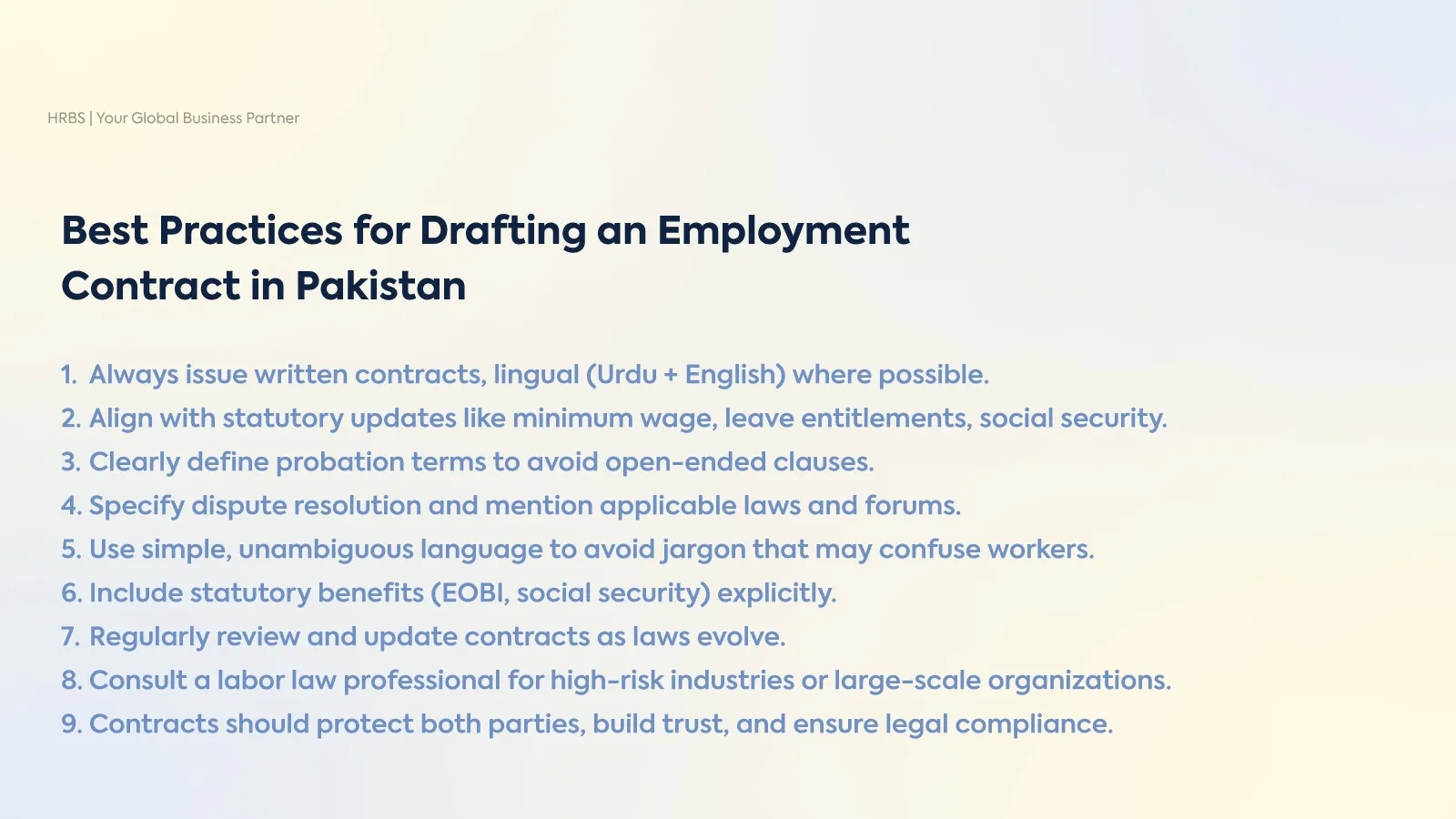
How to Draft an Employment Contract in Pakistan
A well-drafted employment contract is the foundation of a clear, compliant, and secure working relationship in Pakistan. The following best practices ensure your contract meets legal requirements, protects both parties, and minimizes disputes.
- Identify Both Parties Clearly: List the full legal names and contact details of the employer and employee. This eliminates ambiguity and establishes a formal agreement.
- Define Job Title, Duties, and Scope of Work: Clearly state the job title and describe the main responsibilities. Include any additional tasks that may reasonably be expected. This prevents future disputes over role boundaries.
- Specify Duration and Type of Employment: State whether the contract is permanent, fixed-term, probationary, or project-based. For fixed-term or project roles, include the start and end dates.
- Detail Working Hours, Overtime, and Place of Work: Define standard working hours, rest periods, and overtime rules. Mention the primary workplace and any flexibility for remote or hybrid arrangements.
- State Compensation, Payment Schedule, and Benefits: Clearly outline the salary, payment frequency, bonuses, and allowances. Include mandatory benefits like EOBI, social security, and any additional perks such as medical insurance or gratuity.
- List Leave Entitlements: Specify annual, casual, sick, and maternity/paternity leave. Make clear how leave is earned, requested, and approved.
- Describe the Probationary Period (If Applicable): If the role includes a probationary period, state its duration and the conditions for confirmation or termination.
- Set Out Termination Conditions: Define notice periods for termination by either party, valid grounds for dismissal, and any severance or gratuity due. Ensure these terms comply with Pakistani labor laws.
- Include Confidentiality Clauses: Protect business information with confidentiality clauses. If applicable, add reasonable non-compete restrictions, but ensure they do not violate legal limits.
- Specify Dispute Resolution Procedures: Indicate how disputes will be resolved, usually through labor courts or arbitration. This provides a clear path if disagreements arise.
How HRBS Can Help With Employment Contracts in Pakistan?
At HRBS, we provide support for hiring, managing, and paying employees in Pakistan, removing the complexity of local payroll, tax, and labor law compliance. Whether you operate locally or internationally, we streamline every step from contract drafting to payroll processing and statutory reporting, ensuring full legal compliance and operational efficiency.
- Compliant Contract Drafting: We prepare clear, legally sound employment contracts tailored to Pakistani labor laws. Our agreements cover job duties, salary, working hours, leave, benefits, termination rules, and dispute resolution, reducing misunderstandings and protecting both parties.
- Payroll Management: We handle payroll processing, tax deductions, and social security contributions (EOBI, provincial schemes) on your behalf. This ensures employees are paid accurately and on time, with full compliance to tax and labor regulations.
- Employer of Record (EOR) Solutions: For companies without a local entity in Pakistan, HRBS act as the legal employer. We manage all employment contracts, payroll, tax, and benefits administration so you can focus on managing your team while we ensure compliance with local laws.
- Remote and Flexible Hiring: We support remote, contractor, and full-time hiring, handling contracts, payments, and statutory benefits for all worker types. This flexibility lets you scale your team as needed, without administrative burden.
- Employee Benefits Administration: We administer statutory employee benefits, including paid leave, social security, EOBI, workers’ compensation, and maternity leave, ensuring consistent compliance across your workforce. Our systems handle claims, deductions, and eligibility tracking for all required benefits, so you avoid delays, penalties, or confusion.
Ready to hire in Pakistan? Get a free compliance check and payroll setup schedule your expert consultation now.
FAQs
Is a written employment contract mandatory in Pakistan?
Yes, written appointment documents are mandatory under local labor regulations, such as the West Pakistan Standing Orders framework 1968. Employers must issue a formal written contract upon hiring, transfer, or promotion to establish clear terms, protect both parties, and prevent future disputes in labor courts.
What should be included in a probation clause?
A probation clause must state the trial duration, which typically ranges from three to six months depending on the role. It should outline performance review standards, criteria for passing probation, and the right of either party to end the agreement without notice during this initial trial timeframe.
What must be included in an employment contract in Pakistan?
Every employment agreement must outline core details including the full legal names and National Identity Card (CNIC) numbers of both parties, the official job title, daily operational duties, and the base monthly salary in Pakistani Rupees alongside payment frequency. Contracts must also specify standard work hours, rest breaks, overtime conditions, earned paid time off, sick leave, casual leave balances, mandatory benefit contributions for old-age pensions and healthcare networks, notice periods, and termination protocols.
Are verbal employment contracts valid in Pakistan?
Verbal agreements violate statutory requirements that mandate written appointment orders. Relying solely on verbal terms creates severe legal vulnerabilities for businesses, making it difficult to enforce workplace rules or defend against labor court disputes.
What happens if an employment contract does not follow Pakistani labor laws?
Non-compliant contracts hold zero legal weight in labor courts. If an agreement violates minimum wage standards, caps work hours incorrectly, or strips mandatory benefits, courts override the contract terms and enforce statutory protections. Employers facing such violations experience heavy financial penalties, back-pay orders, and formal labor complaints.
How can an employment contract be changed or terminated in Pakistan?
Changing contract terms requires mutual written consent from both employer and employee. Termination requires valid cause, such as redundancy or proven misconduct, alongside a written notice period typically lasting 30 days for permanent staff or severance pay, plus full clearance of final dues and gratuity.
What are the main types of employment contracts used in Pakistan?
Pakistan labor structures recognize several distinct agreement types. Permanent or indefinite contracts secure ongoing roles without a fixed end date for long-term tasks, while fixed-term agreements cover seasonal work or short-term needs with defined start and end dates. Probationary contracts establish a trial timeframe to evaluate new hires before permanent placement, and project-based or part-time contracts govern specific deliverables or reduced workweek hours. Additionally, apprenticeships and temporary contracts manage formal on-the-job training or short-term workload spikes.
What are an employee’s basic rights under a Pakistani employment contract?
Employees hold non-negotiable statutory rights regardless of contract terms. These include the receipt of at least the provincial minimum monthly wage without unauthorized deductions, a capped workweek of 48 hours with paid premium overtime, guaranteed paid annual vacation, sick leave, and casual leave balances, mandatory enrollment in old-age pension programs and provincial healthcare systems, and full protection against workplace harassment, wage discrimination, and unfair dismissal.