Selecting senior management influences overall corporate outcomes. A wrong choice at the executive level can cost a company heavily and delay expansion goals. Meanwhile, capable leaders know exactly how to steer a business through difficult market changes and keep teams focused. Securing top professionals requires more than posting an online job ad and waiting for submissions. Instead, a specialized strategy reaches high-performing “passive candidates”—individuals who are already successful in current positions and are not actively seeking employment.
We outline how executive search functions, how various hiring models suit financial limits, and how to accurately evaluate candidate capabilities using practical interviews and reference checks. By following this approach, companies prevent expensive hiring mistakes and make confident, data-backed choices for long-term success.
What is Executive Search?
Executive search is a specialized recruitment process used to fill top-level leadership roles like chief executive officers, chief financial officers, board members, and senior management. Unlike standard hiring, which relies on public job listings to attract active job seekers, this targeted methodology focuses on identifying and engaging passive candidates who are successful in current positions and do not browse open job boards.
The process operates with strict discretion to protect corporate plans and candidate privacy during leadership changes, uses thorough industry research to map talent landscapes, and applies detailed evaluations to test leadership skills and workplace fit. Organizations use this service to reduce financial risks from costly hiring mistakes and secure qualified leaders who support long-term business goals.
The Executive Search Process: A Complete Breakdown
Finding senior leadership requires a clear workflow to minimize hiring risk and secure qualified talent. The system follows these operational stages:
- Define Role Needs: Outline the exact background, skills, and leadership traits required for the position. Establish key performance indicators, reporting structures, and specific business challenges the leader must solve, such as scaling operations or entering new markets. This ensures the hiring team focuses only on candidates who match business goals and workplace environments.
- Map the Industry: Research competing companies and target sectors to locate where top leaders currently work. Analyze competitor organizational sizes, geographic footprints, and market positioning to identify available talent pools before starting outreach.
- Reach Out to Passive Candidates: Contact successful professionals directly through professional networks instead of waiting for online job board applications. Use personalized conversations focused on career growth and company vision rather than posting open job descriptions, which uncovers qualified leaders who are happy in current roles.
- Protect Privacy: Keep all recruitment communications entirely confidential to safeguard business expansion plans, prevent market rumors, and protect the current employment status and reputation of candidate leaders.
- Evaluate Capabilities: Look past resumes by using structured behavioral interviews, practical skill tests, and independent reference checks to measure actual past performance, crisis management, and team fit.
- Review Final Candidates: Present a small group of top finalists along with interview feedback and performance data so decision-makers can compare options clearly. Cross-reference candidate strengths against the initial role requirements to make an objective final choice.
- Handle Offers and Negotiations: Manage compensation discussions by benchmarking local salary data, bonuses, and benefits. Address potential counteroffers from current employers and finalize employment agreements securely to prevent last-minute dropouts.
- Guide New Hires: Provide a clear setup plan, share main goals, and outline expectations early. Establish clear milestone periods so the new leader starts supporting the business and producing results quickly.

Executive Search Models: Making the Right Choice
Selecting the correct executive recruitment model directly impacts hiring costs, timeline delivery, and candidate quality. Different organizational levels, confidentiality requirements, and budgets demand distinct engagement structures:
- Retained Search: Operates as an exclusive partnership where the client pays staged fees throughout the recruitment process. The search firm dedicates full resources to exhaustive market mapping and passive candidate outreach. This model is best suited for C-suite roles, board seats, and highly confidential replacements where precision and deep vetting outweigh speed.
- Contingency Search: Functions as a performance-based model where the recruitment agency receives payment only upon successful candidate placement. Organizations can partner with multiple agencies simultaneously to maximize initial resume volume. This model carries zero upfront financial risk and works best for mid-level management roles with accessible active candidate pools.
- Hybrid / Engaged Search: Combines elements of both approaches by requiring a partial upfront fee to initiate dedicated work, followed by a final success fee upon completion. It provides an exclusive or near-exclusive relationship with balanced cost controls, making it ideal for director or vice president positions that require dedicated focus without a full retained structure.
How to Choose the Right Model
- Role Seniority: Select retained models for executive leadership (CEO, CFO, board directors) and use contingency or hybrid models for mid-to-senior operational management.
- Candidate Availability: Choose retained or hybrid structures when targeting passive candidates who are currently employed and not looking; use contingency when a large active applicant pool exists.
- Confidentiality Needs: Select exclusive retained or hybrid arrangements when open job advertising risks corporate security or market stability.
How to Build a Winning Executive Search Strategy?
Building a structured executive recruitment plan connects corporate targets with targeted hiring actions. A clear plan ensures companies find, evaluate, and secure senior leadership effectively while minimizing disruption.
- Define Core Objectives: Outline operational challenges the incoming leader must solve, such as expanding product lines or fixing supply issues. Connect required skills, background, and leadership qualities directly to long-term company goals.
- Identify Sourcing Channels: Choose whether to partner with independent recruitment agencies, utilize internal teams, or combine multiple methods. Organize direct messaging efforts to reach passive professionals who ignore regular job boards.
- Draft Clear Role Profiles: Write detailed summaries highlighting business impact, growth milestones, and core expectations rather than routine daily tasks. This draws in qualified leaders who fit the workplace culture.
- Coordinate Decision-Makers: Bring board members and senior managers together early in the process. Agree on exact selection criteria and evaluation standards to prevent internal disagreements, confusion, and scheduling delays.
- Benchmark Compensation Packages: Review regional and industry salary standards, bonuses, and equity structures before opening the search. Competitive packages prevent candidate losses during final negotiations.
- Set Confidentiality Rules: Establish strict communication guidelines to protect sensitive corporate restructuring plans and hide the identities of employed candidates from market exposure.
- Track Performance Metrics: Monitor performance indicators such as time-to-fill, shortlist quality, and offer acceptance rates to evaluate and improve the hiring process over time.
Advanced Assessment Techniques for Executive Evaluation
Selecting top leaders requires looking beyond standard resumes and basic interviews. Utilizing structured evaluations allows businesses to analyze how candidates manage operational challenges, guide teams through market transitions, and handle complex corporate scenarios.
- Behavioral Interviews: Question candidates regarding historical workplace events and crisis management. Detailed accounts of past actions provide clear insight into performance under stressful conditions rather than imaginary answers.
- Cognitive and Personality Evaluations: Use objective tests to measure critical thinking, problem-solving capacity, and interpersonal communication. These tools supply standardized data to compare finalists objectively.
- Practical Business Tasks: Present operational problems, such as financial turnaround cases or restructuring scenarios. Reviewing how candidates complete these assignments reveals practical execution capabilities.
- Independent Reference Inquiries: Contact past managers, colleagues, and direct reports outside of the standard list provided by the candidate. Inquire about leadership style, team collaboration, and crisis handling to verify professional background accuracy.
- Culture and Team Fit Review: Discuss workplace operations and collaborative styles openly. Introduce finalists to board directors and team leads to confirm interpersonal harmony and support long-term retention.
How to Measure Executive Search Success?
Evaluating leadership recruitment results requires tracking metrics that go beyond simply filling a vacancy. Measuring long-term business contributions and process efficiency ensures the hiring framework drives sustainable corporate value.
- Time-to-Fill: Measures the total duration from initial search launch to final placement. Standard executive recruitment requires a balanced timeframe to ensure thorough market mapping and rigorous vetting without compromising candidate quality.
- Shortlist Quality: Tracks whether the search process produces a focused group of fully vetted finalists within an established schedule, enabling objective comparison and decision-making.
- Offer Acceptance Rate: Monitors the percentage of accepted employment offers relative to total offers extended. A high rate indicates that compensation packages, bonuses, and equity structures match current market expectations.
- Initial Performance Achievement: Assesses the incoming leader’s tangible business impact during their early operating months, measuring results against pre-established operational targets and company goals.
- Executive Retention and Tenure: Measures the duration of the leader’s employment past standard tenure thresholds, serving as a primary indicator of accurate assessment, smooth integration, and strong cultural alignment.
- Recruitment Return on Investment: Analyzes the total financial impact and productivity generated by the new executive compared to the direct and indirect costs of the search process.
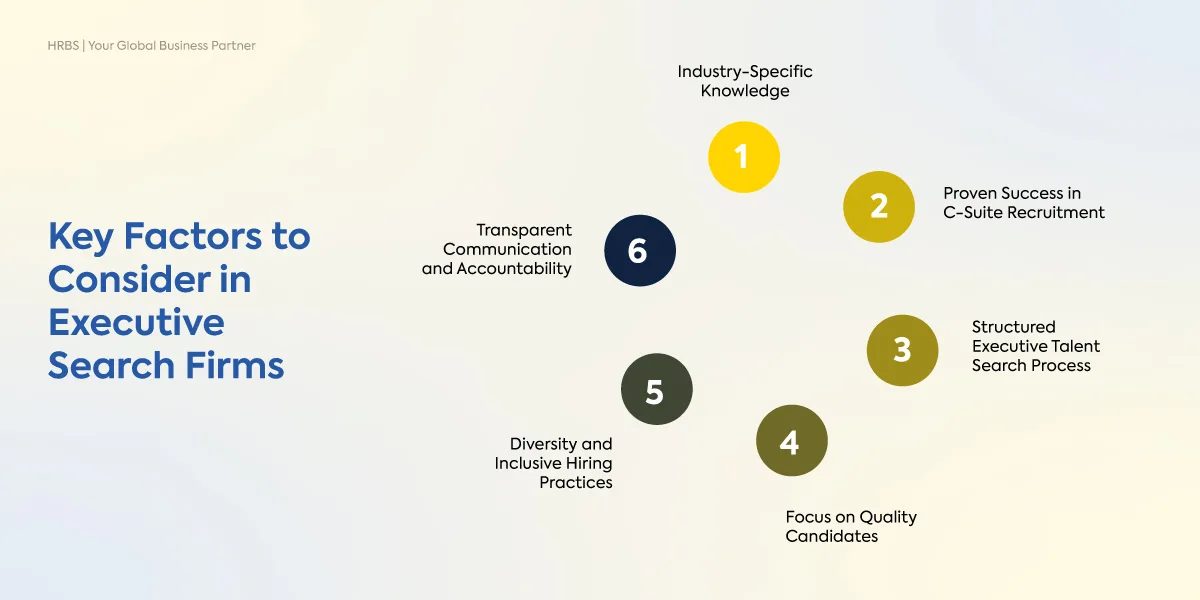
Key Factors to Consider in Executive Search Firms
Selecting an executive recruitment partner directly shapes hiring outcomes. A reliable partner connects organizations with top managers, minimizes recruitment risks, and improves long-term retention. Review these core factors when evaluating a potential agency:
- Industry Expertise: Look for recruiters with deep experience in your specific sector. This ensures they understand your operational environment, market conditions, and regulatory landscape.
- Track Record and Completion Rate: Review the firm’s history with top-level placements. Request data on completion rates, average timelines, and retention duration of past placements to verify capability.
- Search Methodology: A professional firm uses a structured, step-by-step process. They should explain how they find passive talent, evaluate leadership traits, and verify workplace fit instead of relying on basic resume collection.
- Shortlist Quality: Top firms deliver a focused selection of highly matched professionals rather than a large volume of unfiltered options. They invest time in understanding business targets before introducing candidates.
- Inclusive Sourcing Capabilities: Modern search firms use practices that build broad talent pools. Ensure they can source leaders from varied backgrounds to bring different operational viewpoints to your management team.
- Transparent Communication: Your recruitment partner must provide regular updates at every stage. Clear communication regarding timelines and candidate feedback keeps the hiring process moving forward efficiently.
Common Executive Search Challenges and Solutions
Hiring top managers brings specific hurdles. Addressing these issues early ensures successful, long-term placements. Here is how to handle common executive recruitment roadblocks:
- Engaging Passive Candidates: Top executives are secure in current roles and ignore public job boards, requiring direct outreach through professional networks focused on career growth and private discussions rather than open job advertisements.
- Competing for High-Demand Talent: Senior leaders frequently receive multiple competing offers, requiring organizations to streamline internal approvals, maintain continuous dialogue, and benchmark total compensation packages against current market standards before starting the search.
- Verifying Workplace Fit: Candidates with impressive resumes can still struggle if management approaches conflict with company culture, making structured behavioral interviews, practical business tasks, and independent reference checks necessary for evaluating daily decision-making.
- Maintaining Strict Confidentiality: Publicly searching for a C-suite replacement can cause market speculation and disrupt internal morale, requiring strict messaging guidelines, secure data management, and private outreach through specialized partners.
- Managing Extended Timelines: Extended candidate evaluation processes can delay critical business expansions if schedules lack structure, which can be prevented by establishing predefined milestones for shortlist generation and keeping backup candidates engaged throughout final contract stages.
Secure the Right Leaders with HRBS Executive Search
At HRBS, we help organizations across Pakistan and global markets secure senior managers who deliver immediate operational value. Whether filling a Chief Executive Officer, Chief Financial Officer, or upper-level leadership position, our executive search framework connects qualified talent directly with your corporate vision, culture, and long-term targets.
- International Market Coverage: We analyze local regulatory frameworks, regional talent landscapes, and sector-specific hiring trends to identify top-performing managers across Pakistan and cross-border markets.
- Rigorous Candidate Assessment: Our evaluation process moves beyond standard resumes to measure actual past performance, leadership style, problem-solving capabilities, and long-term cultural alignment.
- C-Suite Focus: We target elite professionals with verified track records managing business transitions, corporate growth plans, and large organizational teams.
- Cross-Border Reach: With an extensive international footprint, we source executive talent globally, ensuring your leadership search remains unconstrained by geographic boundaries.
- Retention and Performance Results: Our structured placements increase executive retention rates, improve internal team alignment, and drive measurable business outcomes.
Ready to secure top executive talent? Reach out to discuss your leadership needs or request a customized proposal.
FAQ’s
How is executive search different from standard recruitment?
Standard recruitment fills general or mid-level operational roles using public job postings and active applicants. Executive search is a proactive methodology focused on C-suite and senior leadership roles, targeting employed, passive candidates through confidential market mapping and thorough evaluation.
How long does an executive search typically take?
An executive search typically takes 2 weeks. This timeframe covers comprehensive market research, discreet outreach, multi-stage assessment, and final contract negotiation, balancing thorough vetting with hiring efficiency.
Why is finding passive candidates so important in executive search?
Top-performing senior leaders are secure in current positions and do not monitor public job boards. Accessing this hidden talent pool allows companies to secure industry-leading visionaries who drive sustainable business growth instead of settling for limited active job seekers.
What should I look for when choosing an executive search firm in Pakistan?
Look for proven industry experience, a structured evaluation methodology, local regulatory knowledge, cross-border sourcing capabilities, and a verified track record of long-term executive retention.
Is executive search worth the investment for senior-level hiring?
Yes. A failed executive hire causes severe financial loss, operational disruption, and cultural decline. Executive search minimizes hiring risk through rigorous assessment, ensuring long-term stability and a strong return on investment.
Why is confidentiality vital during the search?
Publicly advertising a C-suite vacancy triggers market speculation, disrupts internal team morale, and jeopardizes the current employment security of candidate leaders. Confidentiality protects corporate stability and candidate privacy.
What is the typical fee structure for an executive search firm?
Executive search firms typically operate on a retained or hybrid structure. Retained firms charge staged milestone fees throughout the recruitment process to fund dedicated market mapping, while hybrid models combine an upfront commitment fee with a final success payment upon placement.
How do executive search firms assess cultural fit for leadership roles?
Firms evaluate cultural fit by combining behavioral interviews, practical business problem simulations, and independent reference checks to measure daily decision-making style, team collaboration, and long-term alignment with organizational goals.