
Expanding a team globally brings immediate challenges. Hiring in foreign markets introduces complex tax codes, mandatory statutory benefits, and strict employment laws that everyday HR software cannot handle. To pay international workers, organizations face a clear choice: use a global payroll provider or partner with an Employer of Record (EOR).
The deciding factor comes down to legal ownership and business registration. A payroll provider calculates wages and sends payments, but your company must first spend months setting up a local corporate entity and take on all legal liability. An EOR acts as the legal employer on paper, managing the local employment contract, tax filings, and compliance risk, while you keep full control over the employee’s daily tasks.
Beyond processing salaries, this choice directly impacts your total cost of ownership. Making the wrong choice leads to delayed market entry, contractor misclassification disputes, and heavy financial penalties. This guide breaks down how both options work side-by-side, helping HR and finance leaders make the best choice for their global expansion plans.
What is an Employer of Record (EOR)?
An Employer of Record (EOR) is a third-party organization that serves as the official legal employer for your international workforce. While your company manages the team’s daily tasks, the EOR assumes all employment liabilities and legal duties in that specific country.
This setup allows you to hire global talent immediately without spending months establishing a local corporate entity. In practice, the EOR manages the complete administrative workload, which includes drafting compliant employment contracts, processing cross-border payroll, calculating exact tax withholdings, and administering mandatory statutory benefits. By outsourcing these tasks, your business ensures strict compliance with foreign labor laws and avoids severe incorrect worker status penalties.
What is Payroll?
Payroll is the financial operation of calculating and distributing compensation to an internal workforce. As the established legal entity, your organization tracks worked hours, computes gross wages, and processes mandatory deductions for local income taxes and statutory benefits to generate final net pay.
With a global payroll provider, your business remains the official legal employer in the target country. The third-party service strictly administers wage distribution and remits exact tax withholdings. Because your company keeps direct control over all hiring and management decisions, your organization assumes the complete liability for satisfying foreign labor laws, finalizing accurate tax filings, and funding mandatory government contributions.
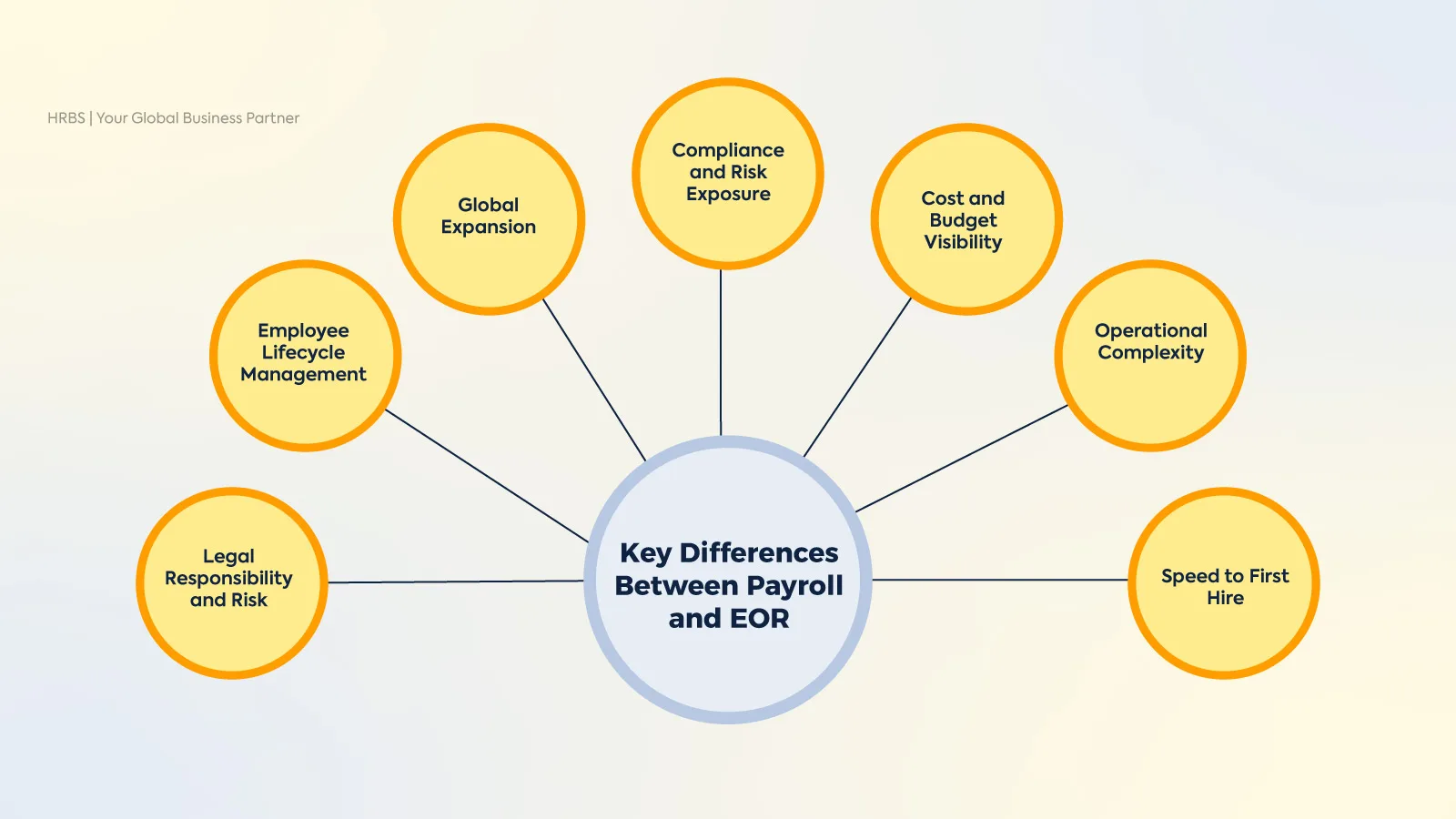
Key Differences Between Employer of Record (EOR) and Payroll
The core contrast between an employer of record and global payroll comes down to legal ownership of the workforce. An EOR acts as the official legal employer for international workers, taking on all compliance risks without requiring a foreign branch. A global payroll service calculates wages and taxes for a corporate entity your company has already registered in that target country.
Here is the complete breakdown of the key differences:
Requirement for a Local Legal Entity
An EOR eliminates the need to set up a foreign branch. The provider uses its own corporate entities, allowing your business to hire internationally right away. A payroll service requires you to first register a corporate entity, open local bank accounts, and secure tax identification numbers before processing payments.
Managing Employment Liability
By utilizing an EOR, the third-party provider takes full legal liability. They sign the employment contracts, manage statutory benefits, and answer to local authorities for labor compliance. If you use a payroll provider, your company takes on the complete legal responsibility for meeting labor laws and filing payroll taxes correctly.
HR and Benefits Administration
An EOR provides a complete human resources solution. The provider administers regional health insurance, mandatory pension contributions, and compliant termination procedures. Payroll systems handle strictly financial execution processing gross wages, deductions, and net pay leaving your internal team to manage onboarding and regional benefits packages.
Timeline for Market Expansion
An EOR allows a business to onboard workers in days. This quick deployment makes the EOR model highly effective for testing new markets before committing to full corporate registration. Setting up a local entity for internal payroll takes months of legal preparation, delaying your ability to hire abroad.
Compensation and Stock Options
Offering company shares to international hires presents distinct challenges. Because an EOR acts as the legal employer, issuing direct stock options requires complex legal structures and additional advisory contracts. When using global payroll, your workers are employed directly by your registered corporate entity, making it much simpler to administer equity plans and include international staff in your standard compensation models.
Overall Expense and Scalability
EOR pricing operates on a flat monthly fee per worker, making it highly cost-effective for testing new regions or small global teams. As your headcount expands, these per-employee expenses multiply. Global payroll runs on a lower processing cost per payslip. Once you hire a larger local team, the fixed operational costs of a foreign branch become cheaper than ongoing EOR charges.
Proprietary Rights and Ownership Transfer
Under an EOR setup, the provider signs the initial employment agreement. To secure your company property, the EOR must implement strict ownership terms that pass all work product and proprietary rights from the employee directly to your business. With global payroll, agreements exist directly between your registered company and the local worker, establishing a direct path for proprietary rights transfer and total ownership of all finished work.
EOR vs Payroll: Comparison Table
| Feature | Employer of Record (EOR) | Global Payroll Service |
| Local Entity Setup | None required; uses provider’s corporate entities. | Requires full legal corporate registration first. |
| Employment Liability | Provider assumes legal risk and signs employment contracts. | Your company handles labor laws and files payroll taxes. |
| HR & Benefits | Manages health insurance, pensions, and compliance. | Payroll systems only process gross wages and net pay. |
| Time to Market | Hire international workers in days. | Takes months of legal preparation to start. |
| Cost Structure | EOR pricing uses a flat fee; better for small teams. | Lower cost per payslip; better for larger teams. |
| Equity & Stock | Needs complex structures to issue company shares. | Simple to include staff in standard compensation models. |
| Termination Process | Handles complete offboarding and calculates severance. | Issues final paycheck; your team handles legal steps. |
| Proprietary Rights | Needs strict terms to pass rights to your business. | Direct path for total ownership of finished work. |
Cost Comparison: EOR vs Payroll
The financial decision between an employer of record and payroll depends entirely on your local headcount. An EOR charges a higher premium per worker but completely bypasses the massive expense of opening a foreign corporate branch. Global payroll systems offer cheap per-employee processing but require you to fund and maintain a fully registered legal entity first. Here is the exact financial breakdown.
The EOR Cost Structure
EOR pricing generally operates on a flat monthly fee, typically ranging from $400 to $800 per employee. Some providers use a percentage model, charging 8% to 15% of the worker’s gross salary.
- Upfront Setup: $0 to $500.
- Monthly Service Fee: $400 to $800 per employee.
- Entity Upkeep: $0. The provider uses their own established legal entity.
- Legal Responsibility: The EOR provider signs the employment contracts and assumes the financial risk of local compliance errors.
The Global Payroll Cost Structure
A global payroll service only processes payments for a company you already legally own in the target country. While the per-payslip cost is low, the corporate overhead is high.
- Upfront Setup (Entity Registration): $15,000 to $50,000+ for legal and financial registration.
- Monthly Service Fee: $30 to $150 per employee.
- Entity Upkeep: $3,000 to $8,000 per month for local accounting and legal operations.
- Hidden Liabilities: Your internal team manages compliance, calculates local payroll taxes, and funds any legal penalties for labor errors.
The Headcount Threshold
For teams under 10 people in a single country, the EOR model is the most cost-effective path. The flat monthly fees remain lower than the baseline costs of running a foreign branch, allowing agile market entry without long-term financial commitments.
Once your local team reaches 15 to 20 workers, the financial advantage changes. At this scale, total EOR service fees outpace the ongoing costs of a local entity. Establishing a foreign branch and switching to standard payroll systems becomes the cheaper long-term approach.
High salary levels and expansion timelines also influence this calculation. Hiring highly paid executives under percentage-based EOR pricing shifts the cost balance with smaller teams. Additionally, long-term operational plans in a target country make upfront entity registration fees worthwhile much earlier than short-term market tests.
When to Use EOR vs Payroll Services
Choosing between an employer of record and payroll depends entirely on your current corporate infrastructure in the target country. Here is exactly when to use each model.
Choose an Employer of Record (EOR)
Select an EOR to prioritize speed and limit local liability. The provider operates established legal entities, assumes legal responsibility for the workers, and manages ongoing HR administration.
- Entering New Markets: Hire talent in a new location instantly, bypassing the months required to register a corporate branch.
- Testing Potential: Place a small, trial sales team in a new area. Flat monthly pricing remains cheaper than the upfront cost for full corporate registration.
- Managing Spread Out Teams: Support a spread out workforce with one or two people in multiple different countries. Opening an entity in each location is cost-wise impractical.
- Short-Term Operations: Staff a specific market for a 12-month project with plans to exit the country later.
Choose Global Payroll Services
Implement global payroll systems when your local operation is permanent, large, and officially set up. Your company keeps full legal responsibility as the official employer.
- You Own a Local Entity: You have established a foreign branch and want to avoid paying a high EOR fee.
- High Headcount Volume: Once your local team reaches 15 to 20 workers, the total monthly fees of an EOR become more expensive than running your own entity.
- Complete HR Control: Your company requires complete control over benefits packages and legal rules without a middleman.
- Mergers and Acquisitions: You bought a foreign company that already has local legal entities, requiring a single platform to pay the recently acquired staff.
How to Choose the Right EOR Provider
Selecting the right employer of record provider directly impacts your international expansion success, compliance risk, and operational efficiency. The wrong choice creates compliance gaps, delays hiring, and exposes your company to legal penalties in foreign jurisdictions.
- Geographic Coverage: Verify whether the provider holds direct, owned legal entities in your specific target hiring regions. High global country counts can be misleading if coverage depends on third-party local partners. Direct presence guarantees faster onboarding, unified data security, and direct operational oversight.
- Transparent Pricing: Select flat monthly fee structures per employee rather than percentage-based billing, which inflates costs as compensation grows. Ensure contract terms clearly outline platform access, onboarding, offboarding, and foreign currency conversion rates to eliminate hidden charges.
- Track Record: Evaluate the provider’s proven history of managing complex labor laws, tax withholdings, and statutory benefits. In-house legal specialists must construct compliant employment contracts that adapt to evolving regional employment codes, insulating your firm from compliance risks.
- Customer Support: Confirm the platform delivers dedicated HR and payroll support within your employees’ local time zones. Prompt response times and local expertise resolve benefits or payroll inquiries quickly, maintaining high employee satisfaction and retention.
- Industry Experience: Partner with a provider experienced in serving your specific sector and business scale. Industry-familiar partners understand local compensation benchmarks, specialized benefit expectations, and equity administration necessary to attract top regional talent.
How to Select Best Payroll Company
Selecting a payroll partner requires evaluating legal compliance, operational capabilities, and pricing transparency. The right provider standardizes operations and scales alongside business expansion. Evaluate options using these key benchmarks.
- Accuracy and Tax Filing: Manual data entry creates compliance risks. High-performing providers guarantee exact wage calculations, deductions, and local filings for taxes. Choose partners offering a strict liability policy where they assume financial responsibility for filing mistakes or late penalties. This guarantees full legal compliance across changing regional regulations.
- Real-Time Reporting: Financial executives require immediate visibility into workforce expenses. Modern payroll software links data instantly across accounting and time-tracking tools, eliminating delays between pay runs and ledger updates. Interactive dashboards allow teams to model labor costs, track overtime trends, and generate audit-ready financial reports instantly.
- Employee Self-Service: Workers expect immediate access to personal financial documents. A self-service portal allows staff to view digital payslips, update direct deposit details, download annual tax forms, and review employment contracts without HR bottlenecks. Direct access lowers administrative workload and improves worker satisfaction.
- Transparency and Scalability: Review fee models prior to signing agreements to uncover hidden costs for onboarding, offboarding, or custom account setups. Reliable payroll services bill using transparent, flat-rate pricing per worker. The platform must easily handle headcount growth, multi-state expansions, and complex organizational structures.
Data Security and Privacy: Processing payroll requires handling highly sensitive salary details and personal records. Reliable partners enforce strict encryption standards, multi-factor authentication, and regular third-party audits to prevent data breaches. Confirm that the provider complies with global data protection laws like GDPR to protect confidential business information.
Questions to Ask Potential Providers
Asking direct questions prevents costly operational mistakes. Require clear responses to these financial and compliance details before choosing a provider.
For Employer of Record Providers
Employer of Record (EOR) providers take on legal responsibility for global workers. Evaluate operational setup and fee models.
- Entity Ownership: “Do you directly own local corporate entities in target countries, or rely on third-party agencies?”
- Pricing Model: “Does the fee scale as a flat monthly rate per worker, or as a percentage of salary?”
- Intellectual Property Rights: “How do local employment contracts guarantee our company retains full ownership of proprietary code and intellectual property?”
- Offboarding Terms: “What specific costs and timelines apply when terminating a contract or transferring a worker to a local entity?”
- Local Regulations: “How do you handle mandatory benefits, pensions, and local employment laws without transferring financial risk?”
- Support Level: “Does support include a dedicated account manager in our time zone, or a shared help queue?”
For Payroll Service Providers
Payroll companies handle compensation for established legal entities. Focus on calculation accuracy, tax compliance, and data security.
- Tax Penalty Coverage: “Do you assume financial obligation for tax penalties or late filings caused by processing mistakes?”
- Complete Fee Schedule: “What extra fees apply for setup, year-end tax forms, or individual transactions?”
- Implementation Timeline: “How many weeks does full onboarding require, and what specific data migration tasks fall on our internal finance team?”
- Global Payouts: “Are salaries deposited through local banking networks, or do international wire transfers trigger extra currency exchange fees for workers?”
- Data Protection: “What specific encryption methods and compliance certifications protect sensitive salary records?”
- International Processing: “How does the software handle multiple currencies and local tax withholdings across different countries?”
- Time Tracking: “Does the application track paid leave and overtime directly, or require external software connections?”
How HRBS Can Help with EOR and Payroll Services
At HRBS, we manage global hiring, legal compliance, and multi-currency payroll processing. By acting as your legal Employer of Record and managing your international compensation tasks, our team allows your business to hire across borders without the heavy costs of establishing local legal entities. We eliminate administrative overhead, protect your company from worker misclassification fines, and guarantee exact tax withholdings in every jurisdiction.
- Fast Onboarding: We complete worker documentation, localized employment agreements, and mandatory healthcare setups in days to shorten hiring timelines.
- Regulatory Compliance: Our in-country legal specialists monitor local labor mandates to prevent worker misclassification penalties and fines.
- Mandatory Deductions: We calculate and process required retirement contributions, social security programs, and local paid leave according to regional labor rules.
- Multi-Currency Payouts: We process compensation centrally and transfer funds directly into local worker bank accounts without extra currency conversion markups.
- Tax Withholding Accuracy: Our local specialists calculate gross wages, government tax withholdings, bonuses, and overtime for every payment cycle.
- Audit-Ready Reporting: Our financial dashboards provide clear tracking of total workforce spending and payment histories for full accounting transparency.
- Centralized Operations: We consolidate your global compensation data into a single location, replacing manual spreadsheets and disconnected software tools.
Expand globally without the legal delays. Schedule a free EOR and payroll consultation. We handle international employment compliance and multi-country payments, allowing you to hire and scale directly from Pakistan.
FAQs
What is the difference between an Employer of Record (EOR) and payroll services?
The core difference lies in legal employer liability and corporate entity ownership. Under a payroll services model, the hiring company must already own a registered legal entity in the destination country to serve as the official legal employer. The payroll provider acts strictly as an administrative processor, calculating statutory tax withholdings, managing benefit deductions, and executing local currency disbursements. Under an employer of record model, the EOR provider acts as the legal employer for international hires. The EOR assumes full legal responsibility for drafting localized employment contracts, maintaining labor law compliance, and remitting statutory taxes through its own established corporate structure.
Can I switch from payroll services to EOR if my company is already established?
Yes. You can transition from localized payroll processing to an EOR by executing contract novations to transfer existing personnel onto our active legal entity. This transition allows you to wind down your local legal presence, eliminating ongoing filing requirements, corporate governance overhead, and local director obligations. Our team manages localized employment agreements that preserve accrued employee seniority and statutory benefits, maintaining operational continuity without introducing permanent establishment risks.
How to choose between payroll services and EOR for expansion?
Your choice depends entirely on legal entity ownership and local operational footprint. Choose payroll services if you hold a registered corporate entity in the host country, as our team calculates local statutory withholdings, manages regulatory tax reporting, and disburses payments. Choose our EOR services if you lack a local legal presence. Under our EOR model, we legally employ your talent on our corporate structure, shielding your organization from entity setup costs, local registration hurdles, and ongoing regulatory maintenance.
What payroll mistakes happen most when managing employees across borders?
Payroll errors involve misapplying statutory benefits, foreign exchange practices, and worker misclassification. Foreign jurisdictions frequently mandate specific local benefits, statutory bonus structures, or required severance accruals that disrupt gross-to-net calculations if overlooked. Additionally, transferring funds without managing conversion causes unexpected net pay discrepancies, also treating full-time staff as independent contractors exposes your organization to severe tax liabilities, interest penalties, and statutory compliance audits.
How quickly do employees start working after you approve hiring?
New international hires begin working as soon as localized employment contracts are signed and identity documentation is verified. Because our corporate entities and tax accounts are active in host jurisdictions, you bypass legal registration delays. Our team instantly generates country-compliant agreements, registers the worker with local labor authorities, and configures statutory benefit deductions, clearing the candidate to start working without delay.
Can HRBS manage both domestic and global payroll and EOR?
Yes. We manage both domestic and cross-border workforce requirements through a single operational framework. For domestic Pakistani operations, our team calculates monthly income tax withholdings under FBR mandates, processes EOBI registrations, and handles provincial social security compliance. Simultaneously, our global EOR network handles international hiring, payroll, and statutory tax compliance across foreign markets, consolidating overall workforce reporting for your leadership.
Do I need a local legal entity to transition independent contractors to full-time employees?
No. You can reclassify international contractors into formal full-time employees without creating a foreign corporate presence. We assume legal employer responsibility, issuing compliant employment contracts. Our team handles local income tax withholdings, social contributions, and mandatory benefit enrollments, eliminating misclassification audit exposure while establishing a legal employment structure for your workforce.
How does an EOR handle international employee terminations?
We execute international offboarding in strict compliance with local labor codes regarding termination grounds, notice windows, and severance mandates. Because foreign jurisdictions rarely recognize at-will employment, our local legal team evaluates tenure, calculates mandatory severance payments, drafts binding mutual separation agreements, and executes final wage settlements to protect your business from wrongful dismissal claims and regulatory fines.
Who owns the intellectual property (IP) when hiring through an EOR?
Your company holds total ownership over all intellectual property, source code, and work product created by the employee. To bridge differences between common law and civil law standards, our employment contracts include direct back-to-back assignment covenants. The employee legally transfers all rights to us upon creation, and our master service agreement immediately passes full ownership directly to your business.