
Severance pay is a payment or package provided to employees after job termination, often based on length of service, salary, and company policy. It helps bridge the gap between jobs by providing financial support during the transition. Employees want to know if they are eligible for severance, how much they should expect, often calculated as a set number of weeks’ pay per year worked, and the factors that influence these amounts. Employers need to understand legal requirements, standard calculation methods, and how to create fair, compliant severance packages.
Amounts vary widely by country and industry, with some regions requiring minimum payouts while others leave it to employer discretion. The amount is commonly calculated using formulas tied to years of service or weeks’ pay, and may include additional benefits like continued insurance or job placement assistance. This guide explains eligibility, calculation methods, key components, and practical steps for both employees and employers.
What is Severance Pay?
Severance pay, sometimes called gratuity in some regions, is a financial payment or package given to employees when their employment ends, usually due to layoffs, company restructuring, or involuntary termination. The amount is typically based on factors such as job tenure, salary, and company policy. Severance packages may also include additional benefits like continued health insurance coverage or outplacement services to support employees during their job transition. Eligibility criteria and calculation methods vary widely by country, industry, and employment contract, making it important for both employees and employers to understand local rules and practices to ensure fair compensation and compliance.
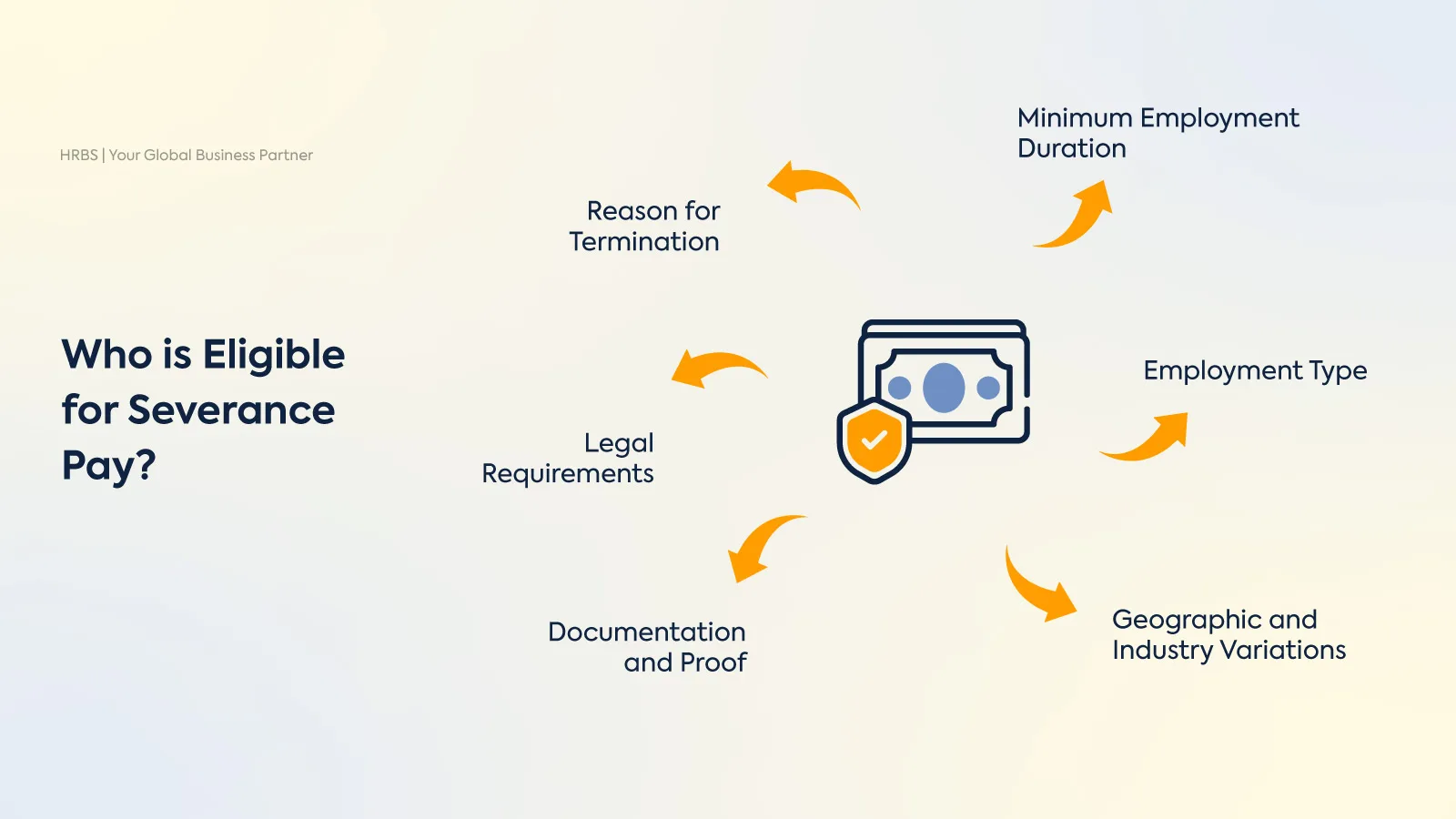
Who is Eligible For Severance Pay?
Eligibility for severance pay is determined by a combination of local labor laws, company policies, and terms outlined in employment contracts. Understanding these eligibility criteria is crucial for both employees and employers to ensure compliance and to secure the benefits employees are entitled to under applicable regulations.
- Minimum Employment Duration: In most countries, eligibility for severance pay requires employees to complete a minimum continuous period of service, which can vary widely, from several months to multiple years, depending on jurisdiction. This threshold ensures severance supports employees who have contributed significant time to the organization.
- Reason for Termination: Severance pay is typically granted when termination occurs due to layoffs, company restructuring, downsizing, or termination without cause. It is generally not provided if the employee voluntarily resigns, is terminated for gross misconduct or violation of company policy, or when a fixed-term contract simply expires.
- Employment Type: Permanent or full-time employees are usually the primary recipients of severance pay. Temporary, probationary, part-time, or contract employees may be excluded unless their contracts explicitly include severance provisions or local laws extend protections to these categories.
- Geographic and Industry Variations: Severance pay rules and eligibility criteria can differ drastically by country and industry sector. For example, in Pakistan, employees who complete more than one year of continuous service are entitled to an end-of-service gratuity. In contrast, in the United States, severance eligibility is largely determined by company policy and employment contracts, as there is no federal law mandating severance pay.
- Documentation and Proof: To claim severance pay, employees typically must provide proof of their employment duration and reason for termination. This can include a termination letter, final paycheck, or employment contract that specifies severance entitlements. Maintaining thorough documentation helps employees assert their rights and facilitates employer compliance.
How Severance Pay Is Calculated
Calculating severance pay ensures fair compensation and legal compliance for employees and employers. The method depends on local labor laws, company policies, and employment contracts. Employees use these formulas to verify entitlements, while employers apply them to avoid disputes and meet legal obligations. Common calculation methods includes:
- Flat Rate: Fixed payout for all employees regardless of salary, tenure, or role.
- Salary-Based: Multiple of regular pay, such as 4–8 weeks’ salary, based on base compensation, most common for mid-level roles.
- Tenure-Based: Payout increases with service length, rewarding loyalty through yearly multipliers, standard in unions and government sectors.
- Position-Based: Senior or specialized roles receive higher amounts due to replacement costs and expertise, typical for C-suite executives.
- Mixed Method: Combines multiple factors (tenure + position + salary) for customized packages in larger organizations, offers flexibility for complex cases.
Severance Pay Formula:
Severance Pay = (Weekly or Monthly Salary) × (Number of Weeks or Months Entitled)
By Pay Frequency:
- Weekly: (Annual Salary ÷ 52) × Weeks Entitled
- Monthly: Monthly Salary × Months Entitled
- Daily (Partial Periods): Daily Rate × Days Worked
Partial Year Calculation:
Partial Severance = Full Year Amount × (Months/Days Worked ÷ 12/365)
Key Calculation Factors
- Last Drawn Salary: Average of final 3–12 months, including basic pay + housing allowance, but excluding one-time bonuses or performance incentives.
- Maximum Limits: Many regions cap payouts at 1–2 years’ salary; some countries limit the total to 24 months’ basic pay only.
- Currency Conversion: Paid in local currency; expatriates receive exchange rate at termination date, plus repatriation allowances where applicable.
- Pre-Tax Amount: Gross calculated first, then statutory deductions (income tax, social security) applied—employees receive net after withholdings.
- Overtime & Allowances: Basic salary typically excludes overtime; fixed allowances (transport, medical) usually included per local statutes.
- Notice Period Offset: Severance, often reduced by pay-in-lieu-of-notice already provided during termination period.
Regional Calculation Examples
Severance pay calculations vary significantly across regions, with each jurisdiction applying its own formula based on factors like years of service and last drawn salary. Understanding these differences is essential for accurate entitlement assessments and compliance.
| Region | Formula Example | Key Notes |
| Pakistan | (Last Salary × Years) ÷ 30 | Gratuity after 1 year |
| US | 1-2 weeks per year (policy-driven) | WARN applies for layoffs |
| UK | 1.5 weeks per year (age 41+) | 20-year service cap |
| UAE | 21 days first 5 yrs; 30 days after | Paid within 14 days |
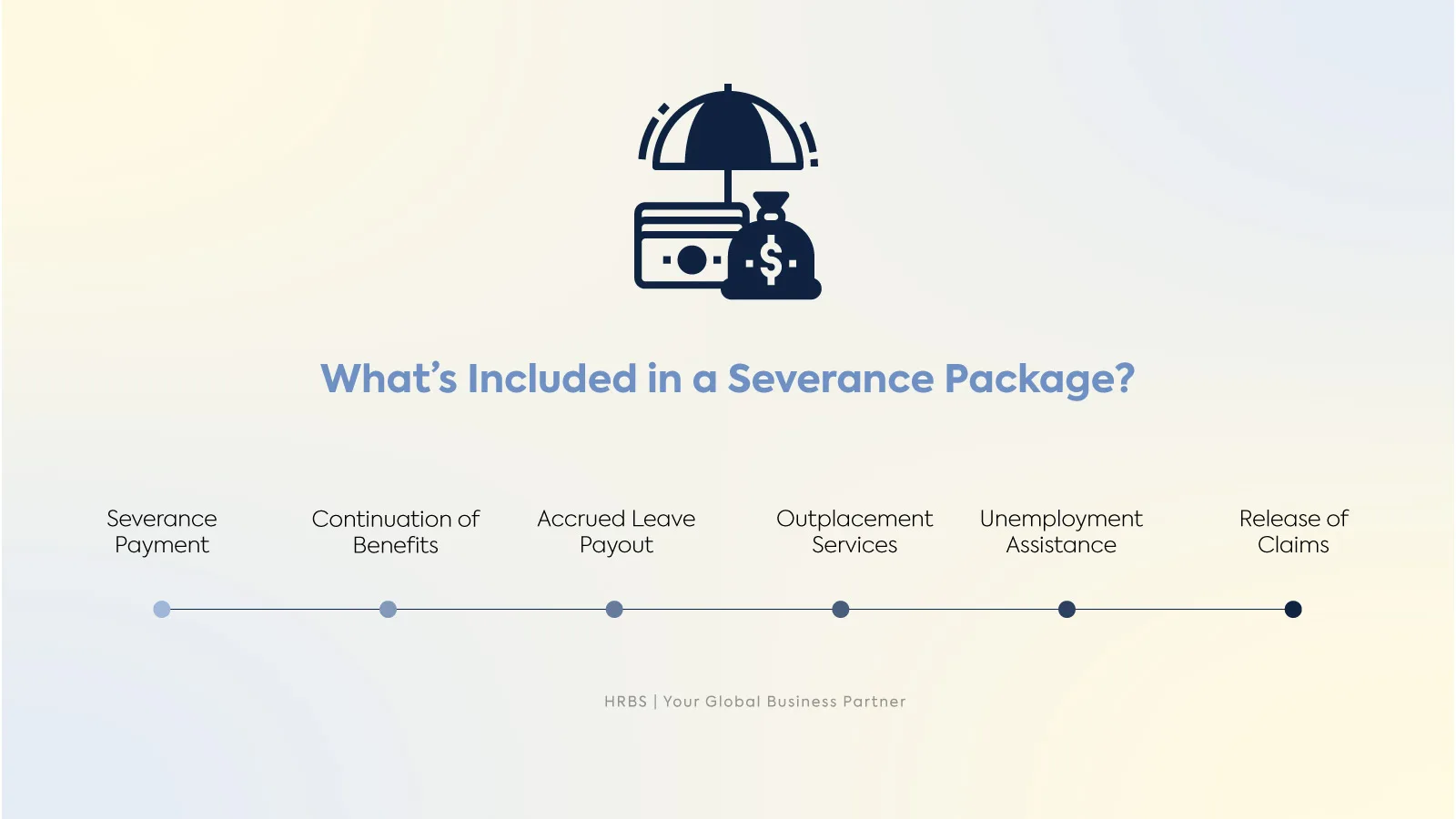
What’s Included in a Severance Package?
A severance package is designed to provide financial and practical support to employees after job loss. The specific items included depend on company policy, employment contracts, and local labor laws, but most packages contain the following key elements:
- Severance Payment: A financial payout calculated based on salary, tenure, or a set formula. This can be paid as a lump sum or in installments, helping cover living expenses during the transition period.
- Benefits: Health, dental, vision, and sometimes life insurance may be extended for a set period after termination, ensuring ongoing coverage and reducing financial stress.
- Accrued Leave Payout: Employees receive payment for unused vacation days, sick leave, or other earned time off, maximizing their final compensation.
- Outplacement Services: Support such as job search assistance, resume writing, interview coaching, and career counseling to help employees find new opportunities quickly and confidently.
- Unemployment Assistance: Guidance and paperwork to help employees apply for unemployment benefits, ensuring they access available government support without delays.
- Release of Claims: Some employers require employees to sign an agreement waiving the right to pursue legal action in exchange for severance pay, protecting both parties and finalizing the separation.
Severance Pay vs. Redundancy Pay vs. Notice Pay
These three termination payments serve distinct legal and practical purposes. Employees claim the correct type based on termination reason, while employers must apply them to avoid compliance violations and payroll errors.
- Severance Pay: This is a voluntary or discretionary payment made by employers to employees upon termination, often for reasons like layoffs, restructuring, or mutual agreement. Severance pay is not always required by law and can include additional benefits beyond statutory entitlements, such as extended health coverage or outplacement services. The amount is typically based on salary, length of service, and company policy.
- Redundancy Pay: Is a statutory payment required by law when an employee’s job is eliminated due to business changes, such as downsizing, restructuring, or closure. Eligibility and calculation depend on local labor laws, length of service, and salary. Redundancy pay is designed to compensate employees for the loss of their position and is not related to performance or conduct.
- Notice Pay: Compensation provided when an employer does not give the legally required advance notice before terminating an employee. The amount is equivalent to the wages the employee would have earned during the notice period. Notice pay ensures employees are not disadvantaged by sudden job loss and is mandatory in most jurisdictions.
How to Negotiate a Better Severance Package
In many cases, the first severance offer is negotiable, especially for mid- to senior-level roles. Employees can often improve terms by calmly presenting their contributions, highlighting potential risks of dispute, and making specific, reasonable requests.
Prepare Before Negotiating
- Review your employment contract, local labor laws, and the initial severance offer to understand your rights and options.
- Identify your priorities, such as pay, benefits, or outplacement services, to focus your negotiation plan.
Focus on Key Improvements
- Ask for a higher payout, extended health insurance, extra bonuses, or payment for unused vacation days to get more from your package.
- Use your time with the company, your work record, and any possible legal claims as reasons to ask for better terms.
Frame Requests as Win-Win
- Offer to assist with knowledge transfer or provide transition support in exchange for better terms.
- Sign a non-disparagement agreement if it helps your case and leads to a positive outcome.
Keep Communication Professional
- Stay calm and polite, and don’t accept the first offer right away, as employers often have some room to adjust the deal.
- Show that you can help with the transition, which can lead to improved terms.
Consult a Legal Advisor
- Get advice from a lawyer if the package is complicated or if you have possible claims, making sure you get everything you are entitled to and don’t give up important rights by mistake.
Tax Treatment of Severance Pay Package
Severance pay is usually treated as taxable income by most tax authorities, but the exact rules depend on the country, the amount paid, and how the payment is handled. Knowing these details helps employees plan their finances and ensures employers follow tax laws.
- Taxable Income: In most countries, severance pay is taxed as regular income and may also be subject to payroll taxes like Social Security or national insurance. Employees must report severance pay as part of their annual income on tax returns.
- Tax Withholding: Employers often take out taxes from severance payments when they are paid. The withholding rate may be different from regular income tax and can depend on whether the payment is made in one lump sum or over several payments.
- Exemptions and Limits: Some countries allow part of the severance pay to be tax-free or taxed at a lower rate, up to a certain amount. This helps reduce the financial burden on employees who lose their jobs.
- Timing and Payment Method: Paying severance in installments instead of one lump sum may change the tax rate and the total tax owed. Employees and employers should look at the best payment method to lower the tax impact.
- Deductions and Credits: Employees may be able to claim certain deductions or credits related to job loss or moving expenses, depending on local tax rules.
- Employer Reporting: Employers are required to report severance payments to tax authorities and give employees the tax documents showing how much was paid and how much tax was taken out.
Employer Best Practices for Severance Pay
Employers that handle severance fairly reduce legal exposure and support a healthier workplace culture.
- Verify Legal Compliance: Cross-check local labor laws, company handbook, and employment contracts against severance formulas and eligibility rules before finalizing offers.
- Document Everything: Provide detailed agreements specifying payout amounts, schedules (lump sum vs. installments), benefit extensions, and signed waivers, use templates reviewed by legal counsel.
- Communicate Transparently: Schedule individual meetings to explain terms, answer questions, and address concerns, record discussions and provide written summaries.
- Apply Consistent Rules: Standardize eligibility (tenure minimums) and calculation methods (salary × years served) across all cases to eliminate discrimination claims.
Employee Checklist Before Accepting Severance Pay
Before accepting a severance package, employees should review several key points to ensure they fully understand their rights and benefits:
- Review the Offer: Carefully read the severance agreement and compare it to your contract and local labor laws. Make sure all terms are clear and match what was promised.
- Check Payment Details: Confirm how much you’ll receive, how payments will be made (lump sum or installments), and when you’ll get the money.
- Verify Benefits: Check if health insurance, life insurance, or other mandatory benefits are included and for how long they’ll last after your last day.
- Unused Leave Payout: Confirm if you’ll be paid for unused vacation days, sick leave, or other earned time off.
- Unemployment Benefits: Ask if accepting severance will affect your ability to claim unemployment benefits and for how long.
- Reference Letter: If needed, request a reference letter from your employer to help with future job searches.
- Get Advice: If the package is complex, or you’re unsure about your rights, talk to a lawyer or financial advisor before signing anything.
Trust HRBS With Your Offboarding Process
Managing severance across borders demands exact compliance with local labor laws, accurate payout calculations, and tax reporting, while protecting departing employees and maintaining trust with your team. One compliance gap can trigger disputes, penalties, or reputational damage that costs far more than the severance itself.
HRBS eliminates these risks by handling global severance from start to finish. Our platform automatically applies jurisdiction-specific rules to generate compliant agreements, calculates entitlements based on contracts and tenure, manages all withholdings, and delivers signed packages ready for payroll. HR teams save hours on manual work and focus entirely on smooth employee transitions and positive offboarding experiences.
Thousands of companies already rely on HRBS for stress-free severance management worldwide. Contact us today and see how we protect your business while supporting your people.
FAQ’s
What is the typical amount of severance pay?
The typical amount of severance pay varies by company policy, employee role, and local labor laws, calculated as weeks of pay per year served, flat lump sums, or months of salary. In Pakistan, end-of-service gratuity equals (last salary × years served) ÷ 30 days for eligible employees under local regulations. Mid-level roles receive base salary multiples, while senior positions include enhanced benefits like extended insurance coverage, always based on specific contract formulas.
Is severance pay mandatory?
Severance pay is rarely mandatory worldwide unless specified in employment contracts or required by local labor laws, with Pakistan mandating end-of-service gratuity after one year of service under the Payment of Wages Act. Many jurisdictions leave amounts to employer discretion, though mass layoffs or collective agreements trigger statutory minimums that employees confirm through contract clauses and jurisdiction statutes.
Does severance pay affect unemployment benefits?
Severance payments typically delay or reduce unemployment benefits eligibility since lump sums count against benefit periods, postponing start dates until exhausted while installments reduce weekly amounts proportionally. Some regions exclude statutory redundancy portions while taxing voluntary severance against claims, requiring employees to file immediately after termination and disclose severance details for benefits administrators to adjust based on local formulas.
What should i do if I receive a severance package offer?
Immediately review the written severance package offer against employment contract and local labor laws to identify minimum entitlements, verifying payout calculations, benefit continuation periods, unused leave payments, and tax withholdings match promised terms while checking waiver language for legal rights affected like wrongful termination or unpaid wages. Request review time, consult employment lawyer for concerns, negotiate gaps before signing, and secure all agreements with exact payment dates.
Can I negotiate my severance package?
Most initial severance offers contain negotiation room particularly for roles with high tenure or revenue impact, allowing counters with specific requests like higher payout multiples, extended health coverage, full unused PTO payment, or outplacement credits while referencing documented contributions, market benchmarks for similar positions, and any contract violations. Propose win-win trades like knowledge transfer for enhanced terms, and get lawyer approval on final release language before accepting.
What documents do i need to claim severance pay?
Employees need employment contract, termination letter, final payslips, performance reviews, and proof of tenure including joining letter and payroll records for disputed situations with correspondence showing company policy violations or unmet obligations. Pakistan requires service certificate for gratuity processing, submitted to HR/payroll within policy deadlines, where digital copies accompany originals.
Does severance pay include unused vacation payout?
Most severance packages include payment for accrued but unused vacation, sick leave, or PTO at regular hourly/daily rates mandatory in many labor codes, verified through written offer inclusion with some employers capping at annual accrual limits. Request itemized breakdown showing hours owed × rate before signing waiver.